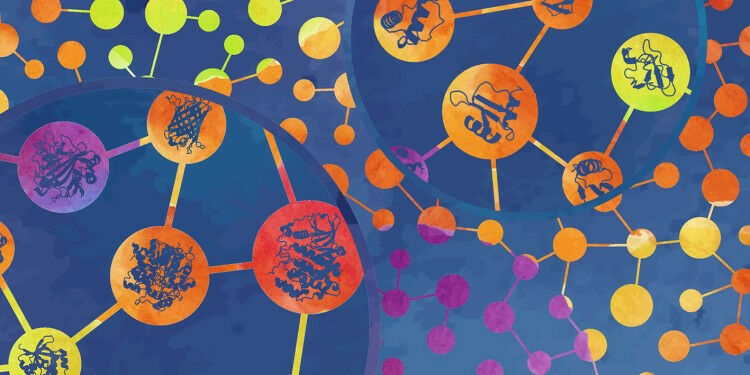
 The evolution of protein structures from the almost endless possibilities of sequence space remains a mystery. One can try to look more closely, as if through a magnifying glass, at the steps nature might have taken to get from one structure to the next.
Team of Czech and German researchers finds small differences deviating from predictions / Study published in -Nature Ecology and Evolution-. The evolution of protein structures from the almost endless possibilities of sequence space remains a mystery. One can try to look more closely, as if through a magnifying glass, at the steps nature might have taken to get from one structure to the next. Mikhail Makarov Proteins are components of every cell. How they have changed in the course of evolution for the purpose of taking on new functions in the body, has long been a subject of research. The fact that proteins can emerge practically out of nothing - out of a new DNA structure emerging at random, in previously non-coding parts of the genome - has only been established relatively recently and has not been the object of much investigation in comparison with the "traditional" evolutionary processes. A team of Czech and German researchers headed by biochemist Dr. Klára Hlouchová from the University of Prague and bioinformatics specialist Erich Bornberg-Bauer from the University of Münster have now, for the first time, carried out experiments comparing de novo proteins with computer-generated proteins as regards their stability and solubility - and have been able to demonstrate small but significant differences between them.
TO READ THIS ARTICLE, CREATE YOUR ACCOUNT
And extend your reading, free of charge and with no commitment.
Your Benefits
- Access to all content
- Receive newsmails for news and jobs
- Post ads