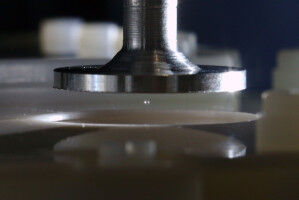
World’s first high-resolution brain developed by 3D printer
In a joint project between MedUni Vienna and TU Wien, the world's first 3D-printed "brain phantom" has been developed, which is modelled on the structure of brain fibres and can be imaged using a special variant of magnetic resonance imaging (dMRI). As a scientific team led by MedUni Vienna and TU Wien has now shown in a study, these brain models can be used to advance research into neurodegenerative diseases such as Alzheimer's, Parkinson's and multiple sclerosis. The research work was published in the journal "Advanced Materials Technologies". Magnetic resonance imaging (MRI) is a widely used diagnostic imaging technique that is primarily used to examine the brain. MRI can be used to examine the structure and function of the brain without the use of ionising radiation. In a special variant of MRI, diffusion-weighted MRI (dMRI), the direction of the nerve fibres in the brain can also be determined. However, it is very difficult to correctly determine the direction of nerve fibres at the crossing points of nerve fibre bundles, as nerve fibres with different directions overlap there.