



Health - Today
AI was supposed to ease doctors' workload - instead they spend hours correcting errors
AI was supposed to ease doctors' workload - instead they spend hours correcting errors



Pharmacology - Today
International trial finds rapid diagnostic testing alone does not reduce antibiotic prescribing for respiratory infections
International trial finds rapid diagnostic testing alone does not reduce antibiotic prescribing for respiratory infections

Social Sciences - Today
Social background shapes how hard children work, according to a study by UC3M
Social background shapes how hard children work, according to a study by UC3M
Innovation - Today
With Robotics Innovation Center, CMU and Hazelwood Partners Sustain Community Collaborations
With Robotics Innovation Center, CMU and Hazelwood Partners Sustain Community Collaborations



news
History & Archeology
Results 301 - 320 of 979.
History & Archeology - 14.09.2022

Although Levantine art has been recognized as World Heritage rock art and Asset of Cultural Interest by the UNESCO, we still have little information on how these cave paintings, typical of the Mediterranean area about 7,500 years ago, were made. Now, a study published in the journal PLOS ONE on the Levantine art site in el Carche (Valencia, Spain) identifies for the first time four different formulas used by the prehistoric communities to get paint by mixing minerals.
History & Archeology - Art & Design - 12.09.2022

Together with the Vrije Universiteit Amsterdam, Netherlands Institute for Conservation+Art+Science+ (NICAS) and Naturalis Biodiversity Center, the Amsterdam Museum conducted research into the origin of the gold of the Golden Coach. Where the gold leaf with which the coach is gilded came from has long been unknown.
Life Sciences - History & Archeology - 09.09.2022
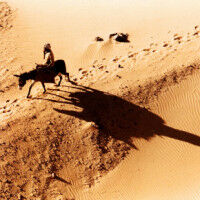
The donkey has shaped the history of humankind, both as a source of power for farm work, and of transportation in sometimes hard to reach areas. To understand the history of the donkey's domestication, teams at the Centre for Anthropobiology and Genomics of Toulouse (CNRS/ Université Toulouse 3 Paul Sabatier) and scientists 1 from 37 laboratories around the world worked together to build and analyse the most complete panel of genomes ever studied for this animal.
History & Archeology - 06.09.2022

Historians show that Ukraine has been an important centre for scientific research over the past 150 years. Ukraine has also been at the heart of the struggle for scientific freedom. Understanding this history can help plan for the future of science in Ukraine. In a comment article in leading science journal, Nature , researchers at the University of Warwick highlight the long struggle for scientific freedom in Ukraine.
History & Archeology - Politics - 05.09.2022

Historian Lorena De Vita unravels impact of local and global security issues of 1952 In 1952, now 70 years ago, Wassenaar was the scene of a historic breakthrough.
Astronomy & Space - History & Archeology - 05.09.2022

History & Archeology - 02.09.2022
Researchers present Prime Minister Rutte with book on the parliamentary history of the 1970s
The issues that arose in the 1970s share striking similarities with our current crises, from energy crises and inflation to concerns about the quality of life on earth. Researchers from Radboud University have written a book about how Dutch parliament dealt with these issues in the 1970s. On 1 September, Prime Minister Rutte was presented with the first copy of this book.
Life Sciences - History & Archeology - 29.08.2022
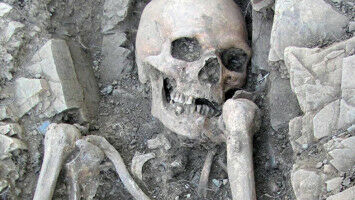
A 1,000-year-old skeleton from Portugal has been uncovered with a rare genetic condition that gives men an extra X chromosome. A group of international researchers has uncovered evidence of a super rare genetic condition that gives men an extra X chromosome, reporting the oldest clinical case of Klinefelter Syndrome to date.
History & Archeology - Life Sciences - 25.08.2022
The Data that Keep on Giving
A 2016 Excavation in Greece Helps Provide Sweeping New Insights into the Evolution of Indo-European Languages Genetic data collected during an excavation of a Mycenaean tomb at Kastrouli near Delphi, Greece, have helped an interdisciplinary team including UC San Diego scientists unveil some of the mysteries of ancient patterns of human migration, culture and the evolution of Indo-European languages across eastern Europe and into West Asia 7,000 to 5,000 years ago.
Health - History & Archeology - 19.08.2022
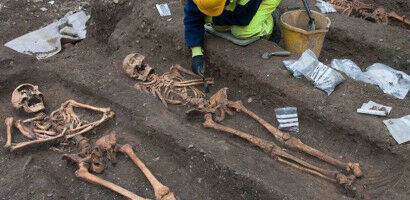
Research examining traces of parasites in the remains of medieval Cambridge residents suggests that local friars were almost twice as likely as ordinary working townspeople to have intestinal worms - despite monasteries of the period having far more sanitary facilities. One possibility is that the friars manured their vegetable gardens with human faeces Piers Mitchell A new analysis of remains from medieval Cambridge shows that local Augustinian friars were almost twice as likely as the city's general population to be infected by intestinal parasites.
Paleontology - History & Archeology - 18.08.2022

Recent research regarding a dinosaur nicknamed April which previously called Manchester Museum home has revealed rare new findings. Scientists made the discovery of gastroliths (stomach stones) inside the Tenontosaurus which is unusually rare. This represents the second oldest occurrence of gastroliths in an ornithopod dinosaur and the first to be identified in a more derived ornithopod.
History & Archeology - 10.08.2022

Distinctive and rare rock crystals were moved over long distances by Early Neolithic Brits and were used to mark their burial sites, according to groundbreaking new archaeological research. Evidence for the use of rock crystal - a rare type of perfectly transparent quartz which forms in large hexagonal gems - has occasionally been found at prehistoric sites in the British Isles, but little investigation has previously been done specifically into how the material was used and its potential significance.
Life Sciences - History & Archeology - 03.08.2022

The worldwide distribution of one of the most important cereal pathogens is the result of human activity. Researchers at the University of Zurich have traced the history and spread of wheat powdery mildew along wheat trade routes and found that mixing of genetic ancestries of related powdery mildew species played a central role in the evolution and adaptation of the pathogen.
Chemistry - History & Archeology - 01.08.2022

In the 1860s, the chemists, Lothar Meyer and Dmitri Mendeleev, independently presented the first periodic system. Since then, the well-known tabular arrangement of the elements has been the guiding principle of chemistry. A team of researchers from the Max Planck Institute for Mathematics in the Sciences and the Interdisciplinary Center for Bioinformatics at the University of Leipzig provides computational approaches based on extensive data sets from the Reaxys chemistry database that explain the development of the first periodic systems.
Environment - History & Archeology - 01.08.2022

Early Bantu speakers crossed through the dense Central African Rainforest 4,000 years ago The study used novel computational approaches and linguistic data from more than 400 Bantu languages to reconstruct the historic migration routes. The project was a collaboration between scientists from the Max Planck Institute for Evolutionary Anthropology in Leipzig, Germany, and researchers at the University of Auckland in New Zealand.
History & Archeology - Life Sciences - 28.07.2022

Ancient genomes from the herpes virus that commonly causes lip sores - and currently infects some 3.7 billion people globally - have been uncovered and sequenced for the first time by an international team involving UCL scientists.
History & Archeology - Environment - 27.07.2022

The hidden archaeological potential of nationally important heritage site Seaford Head has been uncovered through a project involving the UCL Institute of Archaeology. The pilot study involving researchers from Archaeology South-East (ASE), part of UCL Institute of Archaeology, aimed to investigate how an archaeological site at risk from climate change accelerated coastal erosion can be rapidly recorded and communicated to the public before it is lost.
History & Archeology - 26.07.2022
Published the complete study of the Iberian site of Casa de Cabeza of Requena, where wine production for more than 2,000 years has been documented
A multidisciplinary team with the participation of David Quixal, Consuelo Mata, Yolanda Carrión and Guillem Pérez, professors at the University of Valencia (UV), together with UV researchers, just pu
History & Archeology - Earth Sciences - 18.07.2022
In Search of the Lost City of Natounia
Archaeological investigations offer up new findings on the history of Parthian settlements in Iraqi Kurdistan The mountain fortress of Rabana-Merquly in modern Iraqi Kurdistan was one of the major regional centres of the Parthian Empire, which extended over parts of Iran and Mesopotamia approximately 2,000 years ago.
Physics - History & Archeology - 18.07.2022

An international team of researchers, led by the professor of the University of Valencia (UV) Aleix Eixea, has applied for the first time a technique from nuclear physics, Neutron Activation Analysis (NAA), to determine the origin of some flint from Middle and Upper Palaeolithic sites in the current provinces of Valencia and Alicante.


Health - Today
AI was supposed to ease doctors' workload - instead they spend hours correcting errors
AI was supposed to ease doctors' workload - instead they spend hours correcting errors
Pharmacology - Today
International trial finds rapid diagnostic testing alone does not reduce antibiotic prescribing for respiratory infections
International trial finds rapid diagnostic testing alone does not reduce antibiotic prescribing for respiratory infections
Social Sciences - Today
Social background shapes how hard children work, according to a study by UC3M
Social background shapes how hard children work, according to a study by UC3M
Innovation - Today
With Robotics Innovation Center, CMU and Hazelwood Partners Sustain Community Collaborations
With Robotics Innovation Center, CMU and Hazelwood Partners Sustain Community Collaborations