




Health - Today
AI was supposed to ease doctors' workload - instead they spend hours correcting errors
AI was supposed to ease doctors' workload - instead they spend hours correcting errors



Pharmacology - Today
International trial finds rapid diagnostic testing alone does not reduce antibiotic prescribing for respiratory infections
International trial finds rapid diagnostic testing alone does not reduce antibiotic prescribing for respiratory infections

Social Sciences - Today
Social background shapes how hard children work, according to a study by UC3M
Social background shapes how hard children work, according to a study by UC3M
Innovation - Today
With Robotics Innovation Center, CMU and Hazelwood Partners Sustain Community Collaborations
With Robotics Innovation Center, CMU and Hazelwood Partners Sustain Community Collaborations




news
History & Archeology
Results 741 - 760 of 979.
History & Archeology - Social Sciences - 28.04.2014
Prehistoric caribou hunting structure discovered beneath Lake Huron
ANN ARBOR-Underwater archaeologists have discovered evidence of prehistoric caribou hunts that provide unprecedented insight into the social and seasonal organization of early peoples in the Great Lakes region. An article detailing the discovery of a 9,000-year-old caribou hunting drive lane under Lake Huron appears in today's issue of the Proceedings of the National Academy of Sciences.
History & Archeology - Event - 23.04.2014
Ireland’s Troy?
As Ireland marks the millennium of the Battle of Clontarf - portrayed as a heroic encounter between Irish and Vikings which defined the nation's identity - new research argues that our main source for what happened may be more literary history than historical fact. This was more than a literary flourish, it was a work of a superb, sophisticated and learned author Máire Ní Mhaonaigh The standard account of the Battle of Clontarf - a defining moment in Irish history which happened 1,000 years ago this week - was partly a "pseudo-history" borrowed from the tale of Troy, new research suggests.
Environment - History & Archeology - 21.04.2014
Annals of climate
S uppose you want to track climate over the past century. That's easy enough to accomplish with existing records - but what if you want to go back 500 years? What about 1,000 years? What if you want to go back even further? That's where Harvard historian Michael McCormick comes in. McCormick, the Francis Goelet Professor of Medieval History and chair of the Initiative for the Science of the Human Past at Harvard, will lead a project aimed at constructing the most detailed historical record yet of European climate.
Health - History & Archeology - 07.04.2014

We use cookies to ensure that we give you the best experience on our website. You can change your cookie settings at any time. Otherwise, we'll assume you're OK to continue. Arterial disease associated with modern day living is found in 3,000 year old skeletons The first-ever skeletons with atherosclerosis, or clogged up arteries, have been found by archaeologists, according to new research.
Environment - History & Archeology - 31.03.2014
New Southern Hemisphere climate data provides clearer global picture
A new international study has published the most comprehensive Southern Hemisphere reconstruction of past climate records, revealing a clearer climate picture of the globe's temperature history than ever before. The study revealed that over the past 1000 years temperature variations have differed greatly between the two hemispheres, yet it confirmed they shared the one warm period after the 1970s.
Life Sciences - History & Archeology - 11.03.2014
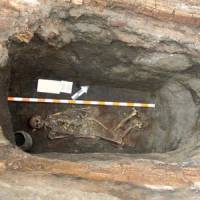
Ancient DNA from archaeological skeletons shows that Europeans had darker skin, hair, and eye pigmentation 5,000 years ago. Anthropologists at Johannes Gutenberg University Mainz (JGU) and geneticists at UCL, working in collaboration with archaeologists from Berlin and Kiev, have analyzed ancient DNA from skeletons and found that selection has had a significant effect on the human genome even in the past 5,000 years, resulting in sustained changes to the appearance of people.
Earth Sciences - History & Archeology - 07.02.2014
Queen Mary helps find Europe’s oldest footprints
The earliest human footprints outside of Africa have been uncovered, on the English coast, by a team of scientists led by Queen Mary University of London, the British Museum and the Natural History Museum. Up to five people left the series of footprints in mud on the bank of an ancient river estuary over 800,000 years ago at Happisburgh in northeast Norfolk.
History & Archeology - 07.01.2014

A diet rich in starchy foods may have led to high rates of tooth decay in ancient hunter-gatherers, says a new study published in the Proceedings of the National Academy of Sciences . Research by a team from Oxford University, the Natural History Museum, London, and the National Institute of Archaeological Sciences and Heritage (INSAP) in Morocco challenges the long-held view that dental disease was linked to the advent of farming.
Social Sciences - History & Archeology - 05.12.2013
New Secrets of the Terracotta Warriors
A new documentary to be broadcast on Channel 4 this weekend is largely based on research carried out by a team from the UCL Institute of Archaeology, in collaboration with colleagues at the Emperor Qin Shihuang's Mausoleum Site Museum in China. New Secrets of the Terracotta Warriors is the first public presentation of some of the work led by Dr Xiuzhen Janice Li, Dr Andrew Bevan, Professor Marcos Martinón-Torres and their team, which involves a number of innovative scientific methods and unexpected results.
History & Archeology - Linguistics & Literature - 29.11.2013
Archaeologists find more bodies at Durham University site
We use cookies to ensure that we give you the best experience on our website. You can change your cookie settings at any time. Otherwise, we'll assume you're OK to continue. Archaeologists find more bodies at Durham University site Durham University archaeologists have found the remains of many more human bodies at a dig on the City's World Heritage Site, providing clear evidence of a centuries-old mass grave.
History & Archeology - 25.11.2013

We use cookies to ensure that we give you the best experience on our website. You can change your cookie settings at any time. Otherwise, we'll assume you're OK to continue. Archaeological discoveries confirm early date of Buddha's life Archaeologists working in Nepal have uncovered evidence of a structure at the birthplace of the Buddha dating to the sixth century B.C. This is the first archaeological material linking the life of the Buddha - and thus the first flowering of Buddhism - to a specific century.
Life Sciences - History & Archeology - 13.11.2013
’Light skin’ gene mirrors socio-cultural boundaries in Indian population
Latest research shows that the presence of the genetic mutation for lighter skin - found in "almost 100%" of Europeans - broadly conforms to many cultural and linguistic differences, as well as ancestral, in the wider Indian population. In India, this genetic variant doesn't just follow a 'classical' theory of natural selection Mircea Iliescu The genetic mutation in SLC24A5 is known to be pivotal in the evolution of light skin, and is responsible for a significant part of the skin colour differences between Europeans and Africans.
History & Archeology - Physics - 01.11.2013
New light shed on history of ancient glass
It's an everyday material we take for granted but now the secrets of how we came to benefit from the many uses of the most unique of substances.. glass, are revealed in a new book by a world-leading archaeologist from The University of Nottingham. The beautifully illustrated Cambridge University Press volume, 'Ancient Glass', by Professor Julian Henderson , is the first monograph of this versatile composite material to combine forensic investigational techniques from both the sciences and the humanities.
Art & Design - History & Archeology - 30.10.2013

Left in an attic and missing for decades, the long-lost Vincent van Gogh painting - "Sunset at Montmajour" - was authenticated by the Van Gogh Museum in Amsterdam in September. After a two-year investigation, art historians and researchers identified the work with pinpoint precision, in part, thanks to a technique based on a canvas "weave-map" developed in a Cornell-initiated project.
Life Sciences - History & Archeology - 22.10.2013
Plant scientists have been studying wrong plant
Scientists have misunderstood one of the most fundamental processes in the life of plants because they have been looking at the wrong flower, according to University of Leeds researchers. Arabidopsis thaliana —also known as thale cress or mouse-ear cress—grows abundantly in cracks in pavements all over Europe and Asia, but the small white flower leads a second life as the lab rat of the plant world.
History & Archeology - Earth Sciences - 17.10.2013
Archaeologists rediscover the lost home of the last Neanderthals
A record of Neanderthal archaeology, thought to be long lost, has been re-discovered by UCL scientists working in the Channel island of Jersey. The study, published in the Journal of Quaternary Science, reveals that a key archaeological site has preserved geological deposits which were thought to have been lost through excavation 100 years ago.
History & Archeology - Life Sciences - 14.10.2013
Battle scarred ant antennae can’t tell friend from foe
Novel research shows damage to fine hairs on ants' antennae's hinders the ability to determine who is a nest mate and who is a threat to the colony. Professor Mark Elgar and his team at the Department of Zoology, University of Melbourne has shown that the right level of ant aggression depends on the density of the fine hairs on the antennae.
History & Archeology - Life Sciences - 14.10.2013
Battle scared ant antennae can’t tell friend from foe
Novel research shows damage to fine hairs on ants' antennae's hinders the ability to determine who is a nest mate and who is a threat to the colony. Professor Mark Elgar and his team at the Department of Zoology, University of Melbourne has shown that the right level of ant aggression depends on the density of the fine hairs on the antennae.
Life Sciences - History & Archeology - 11.10.2013
European hunter-gatherers and immigrant farmers lived side-by-side
Hunter-gatherers and immigrant farmers lived side-by-side for more than 2,000 years in Central Europe, before the hunter-gatherer communities died out or were absorbed into the farming population. In a paper , researchers describe their analysis of DNA and isotopes from human bones found in the 'Blätterhöhle' cave near Hagen in Germany, where both hunter-gatherers and farmers were buried.
History & Archeology - Life Sciences - 01.10.2013
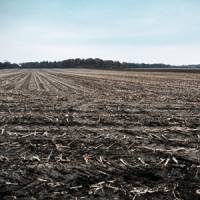
The introduction of farming into Western Europe 7,500 years ago led to dramatic population collapse on a similar scale to the Black Death, according to researchers at UCL. The study, which is published , is the first to show the existence of a 'boom-and-bust' pattern, with decreases in population size as great as 60 per cent following rapid initial population increases of up to three or four times previous levels.


Health - Today
AI was supposed to ease doctors' workload - instead they spend hours correcting errors
AI was supposed to ease doctors' workload - instead they spend hours correcting errors
Pharmacology - Today
International trial finds rapid diagnostic testing alone does not reduce antibiotic prescribing for respiratory infections
International trial finds rapid diagnostic testing alone does not reduce antibiotic prescribing for respiratory infections
Social Sciences - Today
Social background shapes how hard children work, according to a study by UC3M
Social background shapes how hard children work, according to a study by UC3M
Innovation - Today
With Robotics Innovation Center, CMU and Hazelwood Partners Sustain Community Collaborations
With Robotics Innovation Center, CMU and Hazelwood Partners Sustain Community Collaborations