




Health - Today
AI was supposed to ease doctors' workload - instead they spend hours correcting errors
AI was supposed to ease doctors' workload - instead they spend hours correcting errors




Pharmacology - Today
International trial finds rapid diagnostic testing alone does not reduce antibiotic prescribing for respiratory infections
International trial finds rapid diagnostic testing alone does not reduce antibiotic prescribing for respiratory infections

Social Sciences - Today
Social background shapes how hard children work, according to a study by UC3M
Social background shapes how hard children work, according to a study by UC3M
Innovation - Today
With Robotics Innovation Center, CMU and Hazelwood Partners Sustain Community Collaborations
With Robotics Innovation Center, CMU and Hazelwood Partners Sustain Community Collaborations





news
Paleontology
Results 261 - 280 of 323.
Life Sciences - Paleontology - 20.04.2020
Brain’s language pathway dates back at least 25 million years
A research team involving UCL has discovered an earlier origin to the human language pathway in the brain, pushing back its evolutionary origin by at least 20 million years. Previously, a precursor of the language pathway was thought by many scientists to have emerged more recently, about 5 million years ago, with a common ancestor of both apes and humans.
Paleontology - Life Sciences - 15.04.2020
Fossil-inspired flight: pterosaurs hold secrets to better aeronautical engineering
Pterosaurs were the largest animals ever to fly. They soared the skies for 160 million years - much longer than any species of modern bird. However, until now, these ancient flyers have largely been overlooked in the pursuit of bio-inspired flight technologies. In a review, published in Trends in Ecology & Evolution , Bristol researchers outline why and how the physiology of fossil flyers could provide ancient solutions to modern flight problems, such as aerial stability and the ability of drones to self-launch.
Environment - Paleontology - 01.04.2020
Traces of ancient rainforest in Antarctica point to a warmer prehistoric world
Researchers have found evidence of rainforests near the South Pole 90 million years ago, suggesting the climate was exceptionally warm at the time. A team from the UK and Germany discovered forest soil from the Cretaceous period within 900 km of the South Pole. Their analysis of the preserved roots, pollen and spores shows that the world at that time was a lot warmer than previously thought.
Life Sciences - Paleontology - 20.02.2020
Smaller animals faced surprisingly long odds in ancient oceans, Stanford study finds
Giant clams, the largest type of invertebrate included in the study, survive today on tropical reefs in the Pacific and Indian Oceans, but many species from this group are under threat. "People collect them to carve the shells, as with elephant ivory, and to eat the clam because of its supposedly aphrodisiac-like properties," says paleobiologist Noel Heim.
Paleontology - Earth Sciences - 14.02.2020
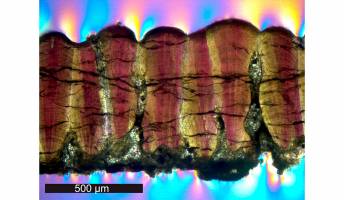
A Yale-led study turns up the heat on a key question about dinosaurs' body temperature: Were they warm-blooded or cold-blooded? According to a new technique that analyzes the chemistry of dinosaur eggshells, the answer is warm. " Dinosaurs sit at an evolutionary point between birds, which are warm-blooded, and reptiles, which are cold-blooded.
Physics - Paleontology - 14.02.2020
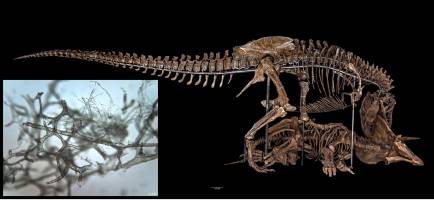
A team of scientists led by Elizabeth Boatman at the University of Wisconsin Stout used X-ray imaging and spectromicroscopy performed at Berkeley Lab's Advanced Light Source (ALS) to demonstrate how soft tissue structures may be preserved in dinosaur bones - countering the long-standing scientific dogma that protein-based body parts cannot survive more than 1 million years.
Life Sciences - Paleontology - 13.02.2020
Boom and bust for ancient sea dragons
A new study by scientists from the University of Bristol's School of Earth Sciences, shows a well-known group of extinct marine reptiles had an early burst in their diversity and evolution - but that a failure to adapt in the long-run may have led to their extinction. Ichthyosaurs were fish-like reptiles that first appeared about 250 million years ago and quickly diversified into highly capable swimmers, filling a broad range of sizes and ecologies in the early Mesozoic oceans.
Earth Sciences - Paleontology - 17.01.2020

Researchers disprove theory of volcanic eruption as reason for mass deaths / Mineralogists and planetologists of the University of Münster participating in worldwide study in "Science' Was it volcanic eruptions in western India or an asteroid impact that caused the death of dinosaurs and many other animal species 66 million years ago? Researchers have been discussing this since the 1980s.
Earth Sciences - Paleontology - 16.01.2020
In death of dinosaurs, it was all about the asteroid - not volcanoes
Volcanic activity did not play a direct role in the mass extinction event that killed the dinosaurs, according to an international, Yale-led team of researchers. It was all about the asteroid.
Paleontology - Earth Sciences - 19.12.2019

Ninety years after Dutch geologists excavated human fossils in central Java, scientists finally have pinpointed the fossils' age at around 120,000 years. In a study reported today in Nature , The University of Queensland's Associate Professor Michael Westaway and Professor Jian-xin Zhao helped to establish the age and a new chronology for "a critical site for understanding the later stages of human evolution".
Paleontology - Environment - 16.12.2019

The impact of an asteroid or comet is acknowledged as the principal cause of the mass extinction that killed off most dinosaurs and about three-quarters of the planet's plant and animal species 66 million years ago. But massive volcanic eruptions in India may also have contributed to the extinctions.
Life Sciences - Paleontology - 27.11.2019
Animal embryos evolved before animals
Animals evolved from single-celled ancestors, before diversifying into 30 or 40 distinct anatomical designs. When and how animal ancestors made the transition from single-celled microbes to complex multicellular organisms has been the focus of intense debate.
Paleontology - Earth Sciences - 04.11.2019
Discriminating diets of meat-eating dinosaurs
A big problem with dinosaurs is that there seem to be too many meat-eaters. From studies of modern animals, there is a feeding pyramid, with plants at the bottom, then plant-eaters, and then meat-eaters at the top. A new study by scientists at the University of Bristol's School of Earth Sciences , published in the journal Palaeontology, shows that dinosaurian meat-eaters, the theropod dinosaurs, specialised a great deal, and so broadened their food base.
Paleontology - Life Sciences - 24.10.2019

Scientists have discovered an extraordinary collection of fossils that reveal in detail how life recovered after a catastrophic event: the asteroid impact that wiped out the dinosaurs 66 million years ago at the end of the Cretaceous Period. Described in a paper published Oct. 24 , the unprecedented find - thousands of exceptionally preserved animal and plant fossils from the first million years after the catastrophe - shines light on how life emerged from one of Earth's darkest hours.
Earth Sciences - Paleontology - 21.10.2019

A new study led by Yale University confirms a long-held theory about the last great mass extinction event in history and how it affected Earth's oceans. The findings may also answer questions about how marine life eventually recovered. The researchers say it is the first direct evidence that the Cretaceous-Paleogene extinction event 66 million years ago coincided with a sharp drop in the pH levels of the oceans - which indicates a rise in ocean acidity.
Environment - Paleontology - 17.10.2019
How ocean ecosystems recovered after mass extinction event 66 million years ago
An international team of scientists, led by the University of Bristol, have produced an unprecedented record of the biotic recovery of ocean ecosystems that followed after the last mass extinction, 66 million years ago. In an article published in the journal Nature , the team, which includes researchers from Southampton, University College London, Frankfurt and California, present a 13 million-year record of fossil plankton dynamics in the aftermath of near annihilation, providing a remarkable glimpse into how the marine ecosystem 'reboots'.
Life Sciences - Paleontology - 02.10.2019

"An experiment of nature" after the end-Cretaceous mass extinction An international research team led by Giuseppe Marramà from the Institute of Paleontology of the University of Vienna discovered a new and well-preserved fossil stingray with an exceptional anatomy, which greatly differs from living species.
Environment - Paleontology - 26.09.2019
Ecosystems take two million years to recover after mass extinctions
It takes ecosystems two million years to recover after a mass extinction and for them to become functional and resilient again, according to new UCL co-led research. The study Hojung Kim and Dr Sarah Alvarez) and academics from Southampton, Frankfurt and California. The team looked at 13 million years' worth of fossil plankton records in the aftermath of near annihilation of ocean plankton, during the Cretaceous/Paleogene mass extinction, providing a remarkable glimpse into how the marine ecosystem 'reboots'.
Life Sciences - Paleontology - 12.09.2019
UChicago Hong Kong campus wins international architectural design award
Researchers from the University of Chicago have used tools developed to explore 3-D movements and mechanics of modern-day fish jaws to analyze a fossil fish for the first time. Combined with CT imaging technology able to capture images of the fossil while it is still encased in rock, the results reveal that the 335-million-year-old shark had sophisticated jaws capable of the kind of suction feeding common to bony fishes like bass, perch, carp and also modern-day nurse sharks.
Paleontology - 29.08.2019
First human ancestors breastfed for longer than contemporary relatives
By analysing the fossilised teeth of some of our most ancient ancestors, a team of scientists led by the universities of Bristol (UK) and Lyon (France) have discovered that the first humans significantly breastfed their infants for longer periods than their contemporary relatives. The results, published in the journal Science Advances , provide a first insight into the practice of weaning that remain otherwise unseen in the fossil record.


Health - Today
AI was supposed to ease doctors' workload - instead they spend hours correcting errors
AI was supposed to ease doctors' workload - instead they spend hours correcting errors
Pharmacology - Today
International trial finds rapid diagnostic testing alone does not reduce antibiotic prescribing for respiratory infections
International trial finds rapid diagnostic testing alone does not reduce antibiotic prescribing for respiratory infections
Social Sciences - Today
Social background shapes how hard children work, according to a study by UC3M
Social background shapes how hard children work, according to a study by UC3M
Innovation - Today
With Robotics Innovation Center, CMU and Hazelwood Partners Sustain Community Collaborations
With Robotics Innovation Center, CMU and Hazelwood Partners Sustain Community Collaborations