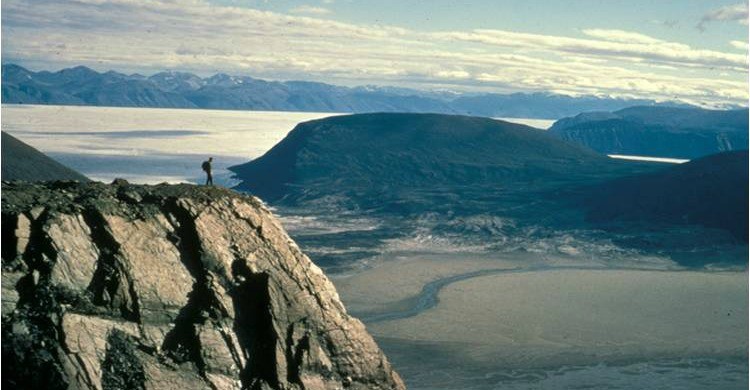
John England in June 1971, standing on the cliffs of the outer Hazen Plateau on Ellesmere Island, silhouetted against the sea ice on Lady Franklin Bay.
As the University of Alberta's Department of Earth and Atmospheric Sciences celebrates its 100th year , one of its longest-serving professors is looking back at his 47 years of Arctic research. It was 1965 when U of A professor emeritus John England first set boots down on the tundra of Canada's far north. He says the opportunity changed his life. "Talk about Elijah being taken away on a fiery chariot, that was me going to the Arctic," he said. England was a first-year geography student at the University of Windsor when a summer field trip to Baffin Island set in motion an eventual doctorate at the University of Colorado, a faculty job at the U of A, breakthrough research and countless memorable moments. England's research focused on the Arctic's environmental variability, which he measured by hiking thousands of kilometres of coastline across the Canadian Arctic Archipelago as well as northwest Greenland. Through the years, England and a revolving team of graduate students put together a diverse record of environmental change in the Arctic, including the history of former ice sheets, related sea level changes "In the summer of 2008 I sat on the coast of northern Banks Island looking out across M'Clure Strait, a 70-kilometre-wide channel," said England.
TO READ THIS ARTICLE, CREATE YOUR ACCOUNT
And extend your reading, free of charge and with no commitment.