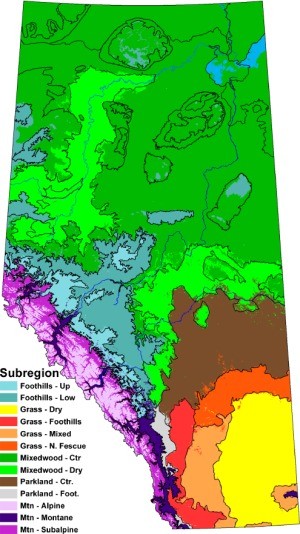
The current distribution of Alberta’s natural subregions, pictured here, is likely to change significantly as the subregions shift northward in response to climate change.
Province's natural regions predicted to shift northward in response to climate change over next century. A new report from an institute at the University of Alberta paints the clearest picture yet of how climate change will reshape the province's landscape. The report from the Alberta Biodiversity Monitoring Institute (ABMI) describes how Alberta's ecosystems are likely to respond to climate change. In Alberta's Natural Subregions Under a Changing Climate: Past, Present and Future , U of A researcher Richard Schneider presents state-of-the-art climate projections for the province and a detailed analysis of how Alberta's ecosystems are likely to shift in response to climate change over the next century. The projections show a range of possible changes to the climate. At a minimum, temperatures in Alberta are expected to increase by 2 C over the next hundred years; all available global climate models predict this outcome. In response, Alberta's ecosystems are projected to shift northward: for example, the parkland landscape around Edmonton will come to resemble the grassland landscape around Calgary.
TO READ THIS ARTICLE, CREATE YOUR ACCOUNT
And extend your reading, free of charge and with no commitment.