(Credit: Simone Marchi, Southwest Research Institute)
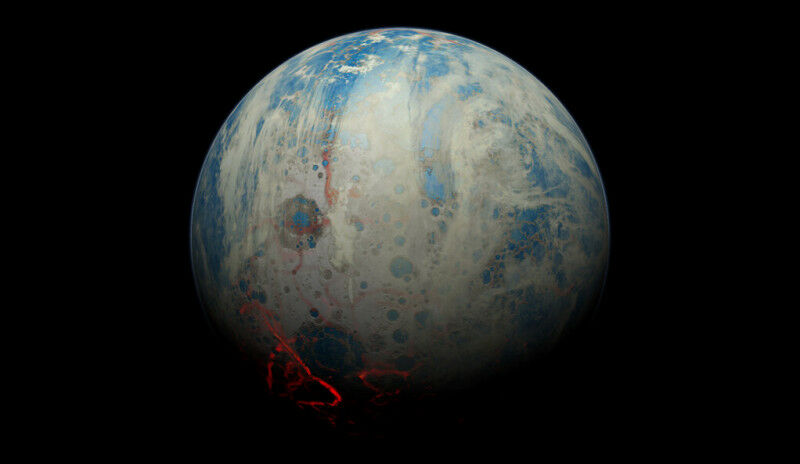
(Credit: Simone Marchi, Southwest Research Institute) - Researchers at Yale and Caltech have a bold new theory to explain how Earth transformed itself from a fiery, carbon-clouded ball of rocks into a planet capable of sustaining life. The theory covers Earth's earliest years and involves "weird" rocks that interacted with seawater in just the right way to nudge biological matter into existence. " This period is the most enigmatic time in Earth history," said Jun Korenaga , a professor of Earth and planetary sciences at Yale and co-author of a new study. "We're presenting the most complete theory, by far, for Earth's first 500 million years." The study's first author is Yoshinori Miyazaki, a former Yale graduate student who is now a Stanback Postdoctoral Fellow at Caltech. The study is based on the final chapter of Miyazaki's Yale dissertation. Most scientists believe that Earth began with an atmosphere much like that of the planet Venus. Its skies were filled with carbon dioxide - more than 100,000 times the current level of atmospheric carbon - and Earth's surface temperature would have exceeded 400 degrees Fahrenheit.
TO READ THIS ARTICLE, CREATE YOUR ACCOUNT
And extend your reading, free of charge and with no commitment.