
This fall, Akhter will begin a job as a software engineer at Apple, on the same photo and camera storytelling team where she did her co-op work term in 2023. She’s thrilled to begin the next phase in her career as a machine learning engineer: the culmination of a lifelong commitment to helping people.
Growing up, Akhter wanted to be a doctor, but in high school she realized her passion for designing better systems while attending a health tech conference. "I heard representatives from hospitals and medical research facilities talk about the systemic problems they faced, and realized that I could do more on a systemic level to help than I could as an individual practitioner," she says.
Overcoming challenges
After the conference, Akhter threw herself into tech, doing an internship at Nokia and co-organizing a mentorship event for tween girls in STEM. However, her first year at Waterloo had its challenges.
Akhter struggled with maintaining good mental health and the transition to adult life, resulting in a failed introductory computer science course. "I felt like such a failure," she remembers. "I didn’t realize how many other people also fail courses at the beginning of a program. I didn’t realize that I wasn’t alone."
Two things, Akhter says, helped her thrive after that difficult first semester. First, she found ways to prioritize her mental and physical health by accessing counselling services and getting involved at a local fitness studio where she did spin, Pilates and yoga classes.
Believing in success
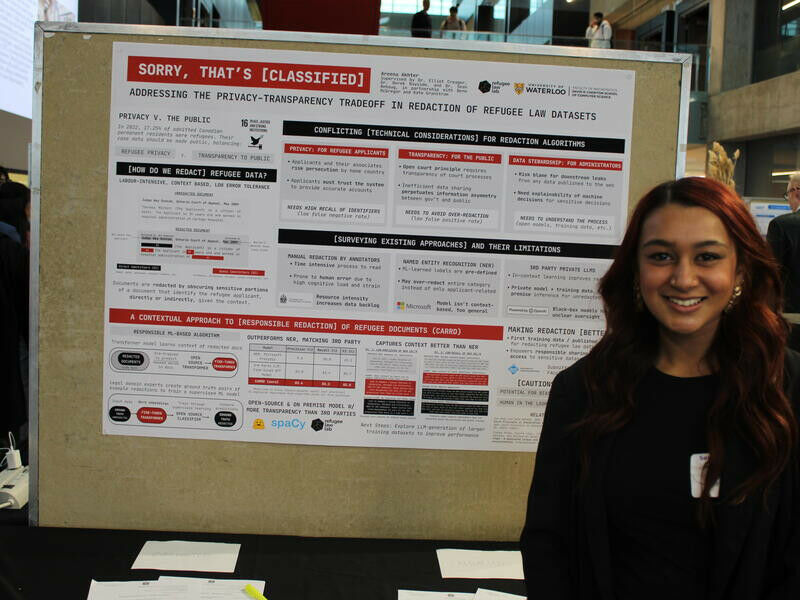
Akhter’s involvement with WiCS reminded her of how many others understood her struggles and her aspirations. The 2020 WiCS president, Iris Chen, gave her a key piece of advice: "She taught me that you have to believe in the inevitability of your success," Akhter shares. "You have to believe that the work you’re putting in now, the times you feel like a failure, are all building towards success that will come. There’s a lot of delayed gratification."In Drs. Maura Grossman and Dan Brown’s course on AI Ethics, Akhter found professors who were concerned with the same human questions that had originally driven her to be a doctor. The principles she learned in that class, she says, led to her capstone project: using machine learning to redact sensitive information in refugees’ publicly-available documents.
However, the most exciting part of Akhter’s time at Waterloo was the series of co-op work terms that she did at high-profile companies across North America, helping to create products that would impact billions of people’s everyday lives. At Bloomberg, she fine-tuned large language models for the legal search intelligence team. At Uber, she built a knowledge graph visualizer to recommend new products. At Apple, she designed machine learning-driven algorithms for new storytelling experiences. "These were all’experiences that equipped me with the technical skills in AI that enabled me to really tackle those human problems."

"I was also so fortunate," she adds, "to find mentors - both men and women - who believed I belonged in tech, and helped me think about how to put my ideas into action."
Ultimately, Akhter hopes that the next phase of her work at Apple is only the beginning of a career in responsible, human-centred AI. "I’ve learned so much about collaborating with diverse communities, knowing when not to create technology, and using tech in ethical ways," she says. "Moving forward, I plan to use tech to align with the human experience - to make life better."