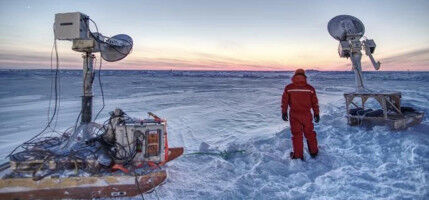
Demystifying complex nature of Arctic clouds
With dancing ribbons of light visible in the sky, a team of researchers flew on a series of scenic and sometimes stormy flights into the cold unknown, trying to learn more about why one of the most frigid places on Earth is warming at a feverish pace. The researchers-a University of Miami atmospheric scientist and her two Ph.D. students-took the flights as part of a nearly two-month-long field campaign aimed at investigating to what extent clouds generated by marine cold-air outbreaks (MCAOs) reflect and potentially contribute to the rapid warming of the Arctic while also sustaining the more extreme weather events of that polar region. "The Arctic is changing rapidly, warming at a rate two to four times faster than the global average," said Paquita Zuidema, professor and chair of atmospheric sciences at the Rosenstiel School of Marine, Atmospheric, and Earth Science and the principal investigator of CAESAR, or Cold-Air Outbreak Experiment in the Sub-Arctic Region. "A consensus on why and how this is occurring is still lacking, and questions remain on how clouds contribute or simply respond to these changes. The more we can learn about Arctic cloud behavior now, the better we can predict the Arctic of the future. Regardless, as the Arctic becomes more accessible, we will need to improve Arctic weather prediction in one of the most poorly observed regions of the planet." MCAOs, which can impact weather patterns around the world, occur when cold, dry air moves over warm ocean waters, with the difference in air and sea temperatures causing the ocean to release large amounts of heat and moisture into the air.