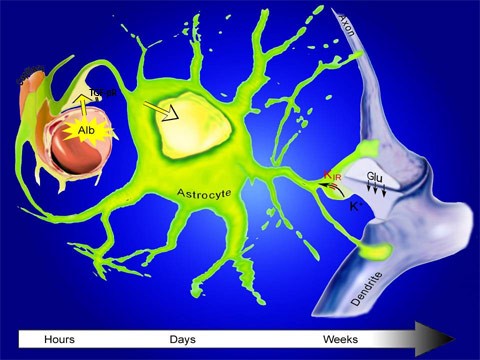
The blood-brain barrier lining the capillaries often breaks after a brain injury, allowing small amounts of blood to leak into the brain. Albumin (Alb) in the blood serum binds to the TGF-beta receptor (TGF-βR) on astrocytes, often called glial cells, triggering a host of changes. One of these prevents astrocytes from mopping up the two neurotransmitters, glutamate (Glu) and potassium ions (K). As a result, these neurotransmitters flood the synapses between nerve cells, where the axon of one neuron touches the dendrite of another neuron, causing a constant excitation that can destroy the nerve cell. These changes take place over a period of days, providing a large window for delivery of drugs to block TGF-beta and prevent such changes.
BERKELEY — Drugs that block a growth factor receptor on brain cells may prevent epilepsy after brain damage, according to a new study appearing in the July 15 issue of The Journal of Neuroscience. Daniela Kaufer, an assistant professor of integrative biology at the University of California, Berkeley, graduate student Luisa P. Cacheaux, and their Israeli colleagues, graduate student Yaron David and neurosurgeon Alon Friedman, found that they could prevent the brain changes leading to epilepsy in rats by treating the animals with a drug that blocks transforming growth factor-beta (TGF-beta) receptors. The blood-brain barrier lining the capillaries often breaks after a brain injury, allowing small amounts of blood to leak into the brain. Albumin (Alb) in the blood serum binds to the TGF-beta receptor (TGF-βR) on astrocytes, often called glial cells, triggering a host of changes. One of these prevents astrocytes from mopping up the two neurotransmitters, glutamate (Glu) and potassium ions (K). As a result, these neurotransmitters flood the synapses between nerve cells, where the axon of one neuron touches the dendrite of another neuron, causing a constant excitation that can destroy the nerve cell. These changes take place over a period of days, providing a large window for delivery of drugs to block TGF-beta and prevent such changes.
TO READ THIS ARTICLE, CREATE YOUR ACCOUNT
And extend your reading, free of charge and with no commitment.