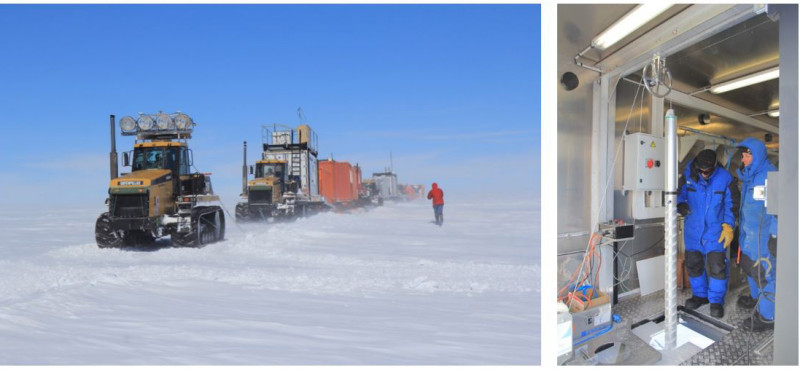
 Photos from the earlier ASUMA (Improving the Accuracy of the Surface Mass Balance of Antarctica) expedition, led by researchers from the CNRS and Université Grenoble Alpes and by the French Polar Institue, with financial support from the ANR. Left: ASUMA expedition caravan. The EAIIST convoy will include a snow mover and five large track tractors pulling containers on sleds. The containers will house warm and cold laboratories and living quarters, in addition to holding scientific instruments, ice cores, and fuel reserves. Right: surface drilling (50-100 m) through hatch in floor of mobile cold laboratory. In the arid expanses of eastern Antarctica, such depths yield data on events a thousand years ago.
From 7 December 2019 to 25 January 2020, a team of scientists from France (CNRS and Université Grenoble Alpes ) and Italy ( Consiglio Nazionale delle Ricerche , Istituto Nazionale Geofisica e Vulcanologia ) will traverse the middle of the Antarctic plateau, travelling 1,318 km, round trip, from the Franco-Italian Concordia research station towards the south pole and back. The expedition, dubbed the East Antarctic International Ice Sheet Traverse (EAIIST), is coordinated by the French Polar Institute, in collaboration with the Italian National Antarctic Programme, and backed by the French National Research Agency and the BNP Paribas Foundation. The two main goals of the EAIIST expedition are to acquire a deeper understanding of the climate 'archives' encoded in ice cores and more accurately predict the rise in sea levels. How the Antarctic continent is reacting to current global warming is one of the greatest unknowns related to climate change. We are already seeing greater melting of the ice sheet, especially along the coast. Yet some models suggest that warming is matched by more intense precipitation on the snowy continent, which would limit the loss in ice sheet mass and offset rising sea levels. French, Italian, and Australian scientists want to test this hypothesis by determining whether more snow has indeed accumulated on the Antarctic plateau.
TO READ THIS ARTICLE, CREATE YOUR ACCOUNT
And extend your reading, free of charge and with no commitment.
Your Benefits
- Access to all content
- Receive newsmails for news and jobs
- Post ads