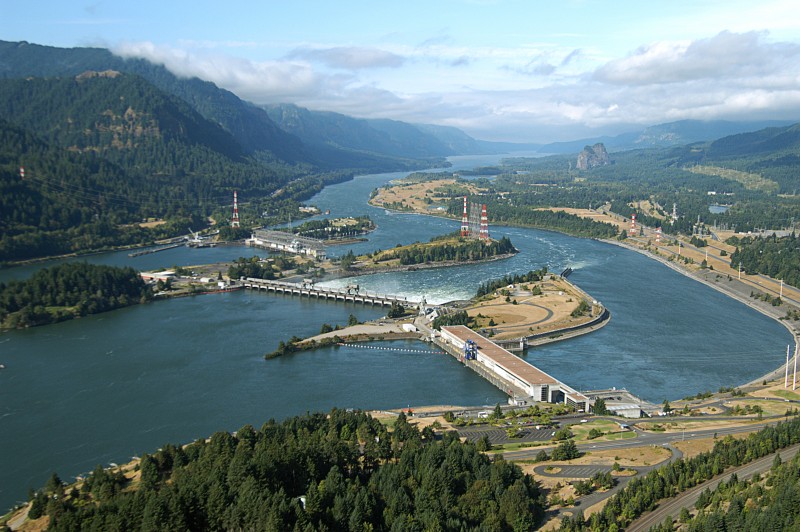
Kevin Wingert, Bonneville Power Administration An aerial view of Bonneville Lock and Dam on the Columbia River. The dam is about 40 miles east of Portland, Ore.
University of Washington - The Columbia River is perhaps the most intricate, complex river system in North America. Its diverse landscape crosses international borders and runs through subarctic, desert and sea-level ecosystems. Surrounding communities rely on the river for fishing, agriculture, transportation and electrical power. As the Earth warms, experts know the Columbia will change - they just don't know how much or when. University of Washington environmental engineers are launching a new study to try to understand how climate change will affect streamflow patterns in the Columbia River Basin. The team will look at the impact of glaciers on the river system, the range of possible streamflow changes and how much water will flow in the river at hundreds of locations in future years. "Getting a new set of streamflow predictions factoring in climate change will help guide long-term decision-making for the Columbia River Basin,” said Dennis Lettenmaier , a UW professor of civil and environmental engineering.
TO READ THIS ARTICLE, CREATE YOUR ACCOUNT
And extend your reading, free of charge and with no commitment.