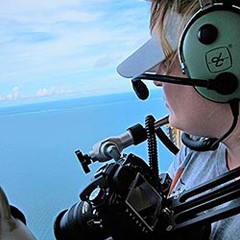
Marine Affairs Student Kasey Cantwell Prepares to Shoot Photos of the Area Impacted by Hurricane Irene Using a Helicopter
— The University of Miami's Rosenstiel School of Marine & Atmospheric Science announced that it has received a challenge grant for $700,000 from the Miami-based Batchelor Foundation to support its exploration research efforts. The funds will be applied toward the acquisition of a helicopter outfitted with a suite of scientific equipment that will serve as the basis for a one-of-a-kind platform for environmental observations at the School. "The slow flight, extremely low altitude and unequaled maneuverability of a helicopter offer an ideal opportunity for critical environmental data collection near the interface between the Earth's surface and the atmosphere, where much of the 'action' is taking place in the climate system," said Roni Avissar, dean of UM's Rosenstiel School. The proposed helicopter will be modular, allowing equipment to be mounted and detached for scientific experiments in several fields of research. Among the measurements taken in the customized helicopter will be: high-frequency three-dimensional components of the wind, humidity, temperature, carbon dioxide and other greenhouse gases and aerosols that can be processed to calculate the exchanges between the Earth surface and the atmosphere. The spatial distribution of these exchanges is not well understood and remains one of the challenging problems facing the climate community. Other applications of the new Helicopter Observation Platform (HOP) will include photography of disaster areas as was conducted in the Bahamas by Avissar and marine geology students following Hurricane Irene in 2011.
TO READ THIS ARTICLE, CREATE YOUR ACCOUNT
And extend your reading, free of charge and with no commitment.