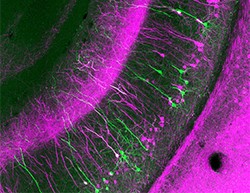
Context-dependent fear memory retrieval involves two distinct populations of hippocampal neurons .
Scientists in the group of Andreas Lüthi have identified two neuronal circuits that mediate the association of contextual information with emotional memories. In their publication in Cell, they describe networks of neurons that are active in the hippocampus and the amygdala, when we associate for example an unpleasant situation with a certain place. They also show that other, parallel neuronal networks are responsible for different integrations of context and emotional memories. We all have experienced this: A hint of a perfume immediately catapults our mind back to the apartment where we used that perfume ten years ago. The dark unlit street instantly brings up the discomfort that we experienced on a similar street two weeks ago. Our memories about smells, sounds, sights, in fact, about all our sensory experiences, are tightly linked to impressions and emotions from the situation in which we experienced them. This not only brings back cherished memories, it also allows us to learn from past experiences and to react appropriately.
TO READ THIS ARTICLE, CREATE YOUR ACCOUNT
And extend your reading, free of charge and with no commitment.