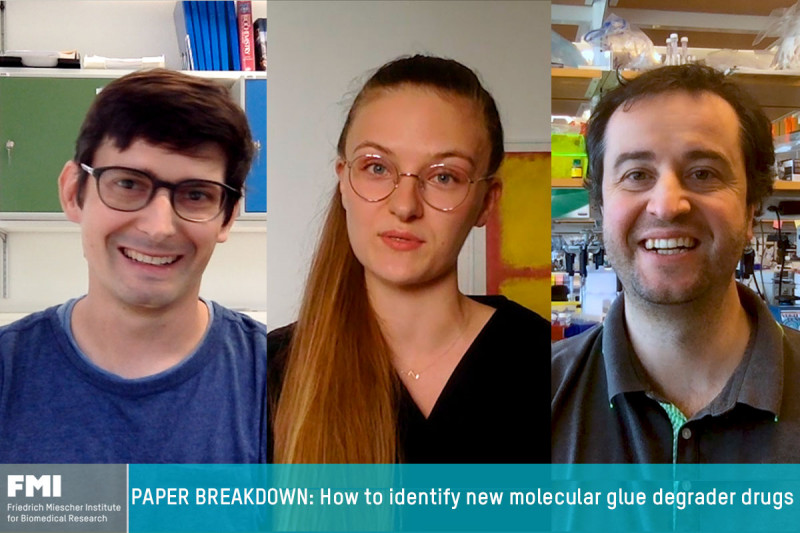
From left to right: Georg Petzold, Zuzanna Kozicka and Mikolaj Slabicki.
From left to right: Georg Petzold, Zuzanna Kozicka and Mikolaj Slabicki. Molecular glue degraders are a new class of drugs that work by facilitating an interaction between a disease-causing target protein and a ubiquitin ligase complex, tagging the target protein for degradation. In this new video, members of the Thomä group, in collaboration with the Broad Institute, explain how they identified and characterized a new molecular glue degrader compound called CR8, showing that it is unlike any of the previously identified molecular glue degraders. To search for new molecular glue degrader compounds, Mikolaj Slabicki, from the Ebert Lab at the Broad Institute, Dana-Farber Cancer Institute and German Cancer Research Center tested a library of thousands of pre-clinical and clinical compounds for their toxicity in various cancer cell lines. Where the toxicity coincided with a high level of ubiquitin ligase component expression, it was a good indication that this compound was working by a degradation-related mechanism. This led to the identification of a kinase inhibitor called CR8 as a molecular glue degrader of cyclin K, an activator protein of cyclin-dependent kinase 12 (CDK12). Using functional genomics approaches, he identified the other proteins needed for CR8 toxicity, and Zuzanna Kozicka and Georg Petzold from the Thomä lab reconstituted the drug-induced complex in vitro and solved its crystal structure.
TO READ THIS ARTICLE, CREATE YOUR ACCOUNT
And extend your reading, free of charge and with no commitment.