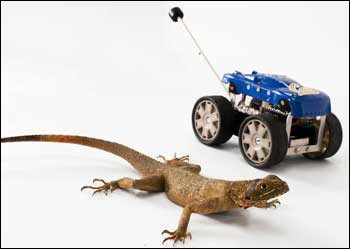
An Agama lizard next to Tailbot, a toy car with an attached tail. Sensors detect Tailbot's orientation and swing the tail upward to keep the robot from pitching forward, similar to the way the lizard uses its tail. Photo by Robert Full lab, UC Berkeley.
An African Agama lizard swings its tail upward to prevent pitching forward after a slip during take-off. Photo by Robert Full lab, UC Berkeley, courtesy of Nature. Leaping lizards have a message for robots: Get a tail! University of California, Berkeley, biologists and engineers - including undergraduate and graduate students - studied how lizards manage to leap successfully even when they slip and stumble. They found that lizards swing their tails upward to prevent them from pitching head-over-heels into a rock. But after the team added a tail to a robotic car named Tailbot, they discovered that counteracting the effect of a slip is not as simple as throwing your tail in the air. Instead, robots and lizards must actively adjust the angle of their tails just right to remain upright. UC Berkeley professor Robert Full discusses his research on lizards and geckos and how the biomechanical principles he and his students discovered apply to the design of robots.
TO READ THIS ARTICLE, CREATE YOUR ACCOUNT
And extend your reading, free of charge and with no commitment.