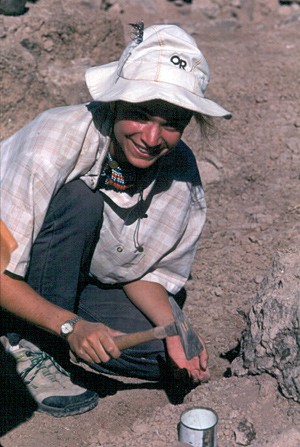
Paleoanthropologist Leslea Hlusko, UC Berkeley associate professor of integrative biology, excavates fossils at the Aramis site in Ethiopia’s Middle Awash region. This location yielded a hominid foot.
BERKELEY — The groundbreaking discovery of the partial skeleton of Ardipithecus ramidus , a hominid species dating back 4.4 million years, is the latest in a long line of contributions UC Berkeley researchers have made toward the elucidation of the human ancestral tree. Some of the world's most significant hominid fossils, including Ar. ramidus , have been unearthed in Ethiopia's Middle Awash Valley, site of the Middle Awash Research Project , established in 1981 by the late J. Desmond Clark, pre-eminent archaeologist and UC Berkeley professor emeritus of anthropology. The project's research area extends along both sides of the modern Awash River in the Afar depression of Ethiopia, north of Gewane town. With cooperation from the Ethiopian government, the project brings together an international team of paleoanthropologists, geologists and archaeologists to study human origins and evolution. To learn more about what it's like to be a hominid fossil hunter, Sarah Yang from UC Berkeley Media Relations interviewed Leslea Hlusko, associate professor of integrative biology and the associate faculty member of the Human Evolution Research Center at UC Berkeley. Hlusko is a co-author of the new Ar.
TO READ THIS ARTICLE, CREATE YOUR ACCOUNT
And extend your reading, free of charge and with no commitment.