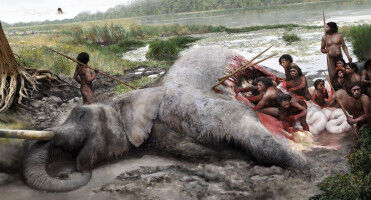
A lifelike rendering of the newly-described early primate species Purgatorius mckeeveri (foreground). Shortly after the extinction of the dinosaurs, the earliest known archaic primates, including this new species, quickly set themselves apart from their competition - such as the archaic ungulate mammal on the forest floor - by specializing on an omnivorous diet that included fruit found in the trees. (Illustration by Andrey Atuchin)
A lifelike rendering of the newly-described early primate species Purgatorius mckeeveri (foreground). Shortly after the extinction of the dinosaurs, the earliest known archaic primates, including this new species, quickly set themselves apart from their competition - such as the archaic ungulate mammal on the forest floor - by specializing on an omnivorous diet that included fruit found in the trees. (Illustration by Andrey Atuchin) The small, furry ancestors of all primates - a group that includes humans and other apes - were already taking to the trees a mere 100,000 years after the mass extinction that wiped out the dinosaurs and most other terrestrial animals, according to a new analysis of fossil teeth in the collections of the University of California Museum of Paleontology (UCMP). The analysis showed that the teeth are the earliest-known fossil evidence of any primate, dating from about 65.9 million years ago - 105,000 to 139,000 years after Cretaceous-Paleogene boundary 66 million years ago that signaled the end of the dinosaur era, except for the dinosaurs' descendants, the birds. The teeth and upper and lower jawbones, from a genus of mammals known as Purgatorius - the oldest genus in a group of now extinct early primates called plesiadapiforms - were collected over the past two decades from the Hell Creek region of northeastern Montana, south and east of Fort Peck Reservoir. The area is known for its T. rex and Triceratops fossils, but also for some of the earliest fossil mammals.
TO READ THIS ARTICLE, CREATE YOUR ACCOUNT
And extend your reading, free of charge and with no commitment.