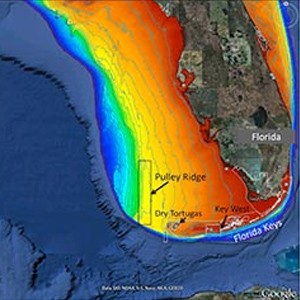
Map of project area showing Pulley Ridge, off the west coast of Florida at depths of 200 to 330 feet in relation to the downstream reefs of the Dry Tortugas and Florida Keys. Colors represent water depth, which ranges from 33 feet (red) to depths of 820 feet or greater (dark blue).
October 17, 2011 — Coral Gables — The National Oceanic and Atmospheric Administration's National Centers for Coastal Ocean Science has awarded nearly $1 million to the University of Miami to investigate how the deep coral reefs of Pulley Ridge may replenish key fish species and other organisms in the downstream reefs of the Florida Keys National Marine Sanctuary and Tortugas Ecological Preserve. Pulley Ridge, a relatively healthy coral ecosystem off the southwest coast of Florida, is home to important commercial and recreational fisheries such as grouper and snapper. With the well-documented decline of Florida's reefs, areas like Pulley Ridge may serve as sources of larvae that can help sustain the Florida Keys' reef ecosystem and the tourism economy that depends on it. With more of this type of information, resource managers will be better positioned to develop more effective strategies to protect these reefs. The $998,703 grant is for the first year of a five-year project led by UM and represents a collaboration of more than 30 scientists at ten different universities pooling their expertise with state and federal agency scientists through NOAA's Cooperative Institute for Marine and Atmospheric Studies at the University of Miami in coordination with the Cooperative Institute for Ocean Exploration, Research, and Technology at Florida Atlantic University. Teams will use technical diving, remotely operated vehicles, and advanced modeling and visualization tools to investigate the role such reefs may play in the replenishment of downstream and adjacent shallow coral ecosystems.
TO READ THIS ARTICLE, CREATE YOUR ACCOUNT
And extend your reading, free of charge and with no commitment.