Evolutionary relationships can be superimposed on a time scale, allowing you to infer missing portions of past diversity. They are powerful tools that complement and refine the known record of extinct diversity. If you visualize evolutionary relationships in the form of branching diagrams and then plot them on a time scale, new patterns begin to emerge, with gaps in the fossil record suddenly filling rapidly.
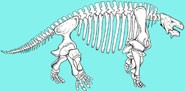
The end-Permian extinction, by far the most dramatic biological crisis to affect life on Earth, may not have been as catastrophic for some creatures as previously thought, according to a new study led by the University of Bristol. An international team of researchers studied the parareptiles, a diverse group of bizarre-looking terrestrial vertebrates which varied in shape and size. Some were small, slender, agile and lizard-like creatures, while others attained the size of rhinos; many had knobbly ornaments, fringes, and bony spikes on their skulls. The researchers found that, surprisingly, parareptiles were not hit much harder by the end-Permian extinction than at any other point in their 90 million-year history. Furthermore, the group as a whole declined and diversified time and time again throughout its history, and it was not until about 50 million years after the end-Permian crisis that the parareptiles finally disappeared. During the end-Permian extinction, some 250 million years ago, entire groups of animals and plants either vanished altogether or decreased significantly in numbers, and the recovery of the survivors was at times slow and prolonged before new radiations took place. By studying the fossil record, palaeontologists can examine how individual groups of organisms responded to the end-Permian event and assess just how dramatic it was.
TO READ THIS ARTICLE, CREATE YOUR ACCOUNT
And extend your reading, free of charge and with no commitment.