Image: David Wood and David Weingeist
Download photo
CAMBRIDGE, Mass. ? Our DNA is under constant siege from a variety of damaging agents. Damage to DNA and the ability of cells to repair
that damage has broad health implications, from aging and heritable diseases to cancer. Unfortunately, the tools used to study DNA
damage are quite limited, but MIT researchers have developed a new tool for rapid DNA damage analysis that promises to make an impact
on human health.
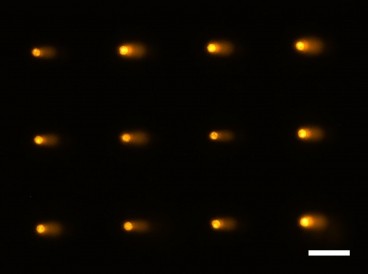
CAMBRIDGE, Mass. Our DNA is under constant siege from a variety of damaging agents. Damage to DNA and the ability of cells to repair that damage has broad health implications, from aging and heritable diseases to cancer. Unfortunately, the tools used to study DNA damage are quite limited, but MIT researchers have developed a new tool for rapid DNA damage analysis that promises to make an impact on human health. The researchers, led by Bevin Engelward, MIT associate professor of biological engineering, and Sangeeta Bhatia, professor in the Harvard-MIT Division of Health Sciences and Technology and MIT's Department of Electrical Engineering and Computer Science, have produced a completely revamped version of a three-decades-old lab test known as the comet assay. This new technique combines the versatility and sensitivity of the comet assay for DNA damage analysis with a robust high-capacity platform, which could make DNA damage analysis routine across a variety of applications, ranging from epidemiology to drug screening. Engelward, Bhatia, postdoctoral fellow David Wood and graduate student David Weingeist describe the technique in a paper that will appear in the Proceedings of the National Academy of Sciences the week of May 3.
TO READ THIS ARTICLE, CREATE YOUR ACCOUNT
And extend your reading, free of charge and with no commitment.