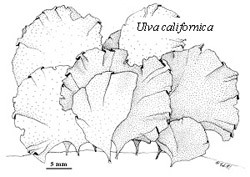
Drawing of the seaweed Ulva californica, common along the southern California coast. This image is part of the DeCew Guide project operated by UC Berkeley's University and Jepson Herbaria. .
A trumpet fish and tiger shark, two vertebrate species represented in the world's museum collections. Collection information on these and all other vertebrates will soon to be collected in the cloud for use by researchers and citizen scientists. (Courtesy of M. Addison) What Google is attempting for books, the University of California, Berkeley, plans to do for the world's vertebrate specimens: store them in 'the cloud.' Online storage of information from vertebrate collections at the Smithsonian Institution, American Museum of Natural History, National Museum of Natural History in Paris, UC Berkeley's Museum of Vertebrate Zoology (MVZ) and from hundreds of other animal collections around the world ' or at least, all collections that include animals with backbones ' will make them readily available to academic researchers and citizen scientists alike. Computing clouds are shared pools of servers that can be accessed from anywhere, anytime, and are far more reliable than computer servers at individual institutions. The project to create VertNet , a cloud-based collection of vertebrate specimens, got off the ground this summer thanks to a three-year, $2.4 million grant from the National Science Foundation (NSF). The effort is led by UC Berkeley museum curators and involves colleagues from the University of Colorado, Boulder; University of Kansas in Lawrence; and Tulane University in New Orleans. VertNet coordinator David Bloom said VertNet would have been invaluable after the 2010 oil spill in the Gulf of Mexico, telling scientists and others about the animals potentially affected.
TO READ THIS ARTICLE, CREATE YOUR ACCOUNT
And extend your reading, free of charge and with no commitment.