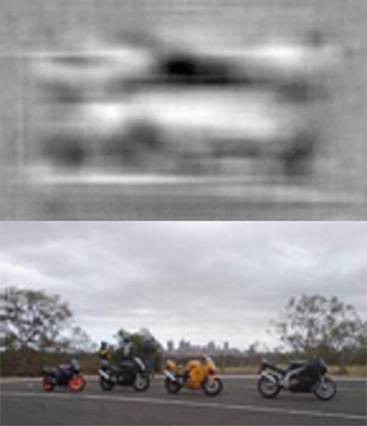
With each of the raw images at left (color), today’s state-of-the-art
object-detection algorithms make errors that initially seem baffling -- such as mistaking distant clouds for a nearby car. A new
technique enables the visualization of a common mathematical
representation of
images (in black and white), which should help researchers understand why
their
algorithms fail.
Object-recognition systems - software that tries to identify objects in digital images - typically rely on machine learning. They comb through databases of previously labeled images and look for combinations of visual features that seem to correlate with particular objects. Then, when presented with a new image, they try to determine whether it contains one of the previously identified combinations of features. Even the best object-recognition systems, however, succeed only around 30 or 40 percent of the time - and their failures can be totally mystifying. Researchers are divided in their explanations: Are the learning algorithms themselves to blame? Or are they being applied to the wrong types of features? Or - the "big-data" explanation - do the systems just need more training data? To attempt to answer these and related questions, researchers at MIT's Computer Science and Artificial Intelligence Laboratory have created a system that, in effect, allows humans to see the world the way an object-recognition system does. The system takes an ordinary image, translates it into the mathematical representation used by an object-recognition system and then, using inventive new algorithms, translates it back into a conventional image. In a paper to be presented at the upcoming International Conference on Computer Vision, the researchers report that, when presented with the retranslation of a translation, human volunteers make classification errors that are very similar to those made by computers.
TO READ THIS ARTICLE, CREATE YOUR ACCOUNT
And extend your reading, free of charge and with no commitment.