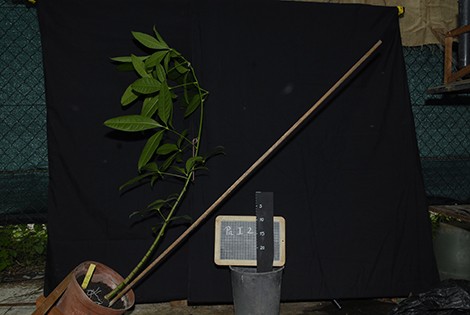
 © Barbara Ghislain, Ecofog laboratory (CNRS/AgroParisTech/Cirad/Inra/Université de Guyane/Université des Antilles). Young Guiana chestnut ( Pachira aquatica ) tree. The tree has been titled and staked. As it has grown it has generated forces in its bark to grow upright. When the tree is released from the stake, the energy accumulated is released and causes the tree to bend.
As the vertical position is unstable—for both trees and humans—mechanisms are needed to offset the effect of gravity. To ensure that they grow vertically, trees need both a “skeletal” system, which is achieved through the stiffness and strength of the trunk material, and a “motor” system to control their posture by generating forces that offset gravity. Although the skeletal function of bark has already been demonstrated, its motor function (as the tree's “muscle”) has generally been overlooked in biomechanical and ecological studies, as wood was considered to be the only tree tissue with active mechanical functions. To understand the role of bark, researchers from the Ecofog laboratory (CNRS/AgroParisTech/Cirad/Inra/Université de Guyane/Université des Antilles) and the LMGC laboratory (CNRS/Université de Montpellier)
1 grew tropical species at a tilted angle. The forces that developed in the stems of the young staked trees produced a stem curvature as soon as the stakes were removed. In certain species, when the bark of the stem was removed this curvature was lost, which demonstrates that the forces responsible for stem up-righting are located in the bark. The mechanism generating these forces is linked to the specific structure of the bark, where the fibers are organized in the form of a trellis.
TO READ THIS ARTICLE, CREATE YOUR ACCOUNT
And extend your reading, free of charge and with no commitment.
Your Benefits
- Access to all content
- Receive newsmails for news and jobs
- Post ads