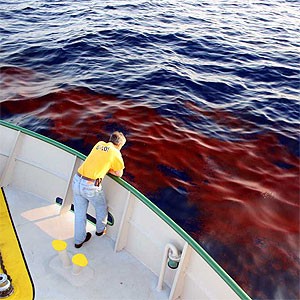
The University of Miami’s 96-foot catamaran the RV/F.G. Walton Smith had just completed a two-week National Science Foundation (NSF) sponsored cruise sampling the deep submerged plumes near the Deepwater Horizon well site.
June 12, 2010 — Virginia Key — A team of dedicated South Florida researchers from the University of Miami's Cooperative Institute for Marine and Atmospheric Studies (CIMAS) and the National Oceanic and Atmospheric Administration's Atlantic Oceanographic and Meteorological Laboratory (NOAA/AOML) were determined to check on whether oil was, as predicted, being pulled into the Loop Current and carried toward the Dry Tortugas. The University of Miami's 96-foot catamaran the RV/F.G. Walton Smith had just completed a two-week National Science Foundation (NSF) sponsored cruise sampling the deep submerged plumes near the Deepwater Horizon well site. NOAA/AOML offered to pay for a few additional days, but the ship which is part of the University National Laboratory System, had to return to Miami on its tight schedule. The best they could do was extend the trip home by 18 hours. Using funding provided through CIMAS, a team was rapidly assembled that included UM and CIMAS oceanographers Tom Lee and Nelson Melo, as well as a group of scientists led by Michelle Wood, director of the NOAA/AOML's Ocean Chemistry Division. A sampling plan was pulled together using particle trajectories calculated by the UM Rosenstiel School of Marine & Atmospheric Science's Coastal Shelf Modeling Group, in combination with information provided by Roffer's Ocean Fishing Forecast Service (ROFFS) and remotely sensed images from UM's Center for Southeastern Tropical Advanced Remote Sensing (CSTARS).
TO READ THIS ARTICLE, CREATE YOUR ACCOUNT
And extend your reading, free of charge and with no commitment.