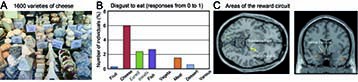
 © Jean-Pierre Royet/Centre de Recherche en Neuroscience de Lyon (CNRS/INSERM/Université Claude Bernard Lyon 1/Université Jean Monnet). (A) There are almost 1600 varieties of cheese. (B) Aversion to cheese (responses from 0 to 1 on a scale of 11 includes the highest population of individuals among those with food aversions. (C) On the left: two areas of the reward and aversion circuit are more strongly activated in people who dislike cheese than in those who like it. On the right: another small structure involved in the motivation to eat food is not activated in people who hate cheese, whereas it is activated in those who like it.
Until now, the reason why some people hate cheese has been a mystery. Researchers at the Centre de Recherche en Neuroscience de Lyon (CNRS/INSERM/Université Claude Bernard Lyon 1/Université Jean Monnet) and the Laboratoire Neuroscience Paris Seine (CNRS/INSERM/UPMC) have just elucidated it. Their results are published online on the Frontiers in Human Neuroscience website. It is difficult to remain lukewarm when faced with a ripe camembert or goats cheese: people love it or hate it. France may well be the country that has the largest number of cheese varieties (almost 1600), yet many there are disgusted by it. Aversion is an extremely powerful factor in the animal world: it is a key element for survival, hence the importance of studying the cerebral mechanisms at play. Why cheese? Because it seemed to the researchers that many people do not like this type of dairy product.
TO READ THIS ARTICLE, CREATE YOUR ACCOUNT
And extend your reading, free of charge and with no commitment.
Your Benefits
- Access to all content
- Receive newsmails for news and jobs
- Post ads