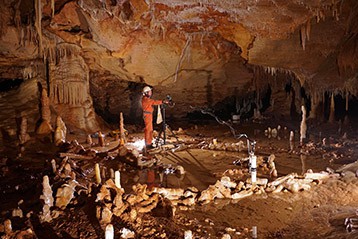
 © Etienne FABRE – SSAC. Measurements for the 3D magnetic study in the Bruniquel Cave.
Deep inside Bruniquel Cave, in the Tarn et Garonne region of southwestern France, a set of man-made structures
1 336 meters from the entrance was recently dated as being approximately 176,500 years old. This discovery indicates that humans began occupying caves much earlier than previously thought: until now the oldest formally proven cave use dated back only 38,000 years (Chauvet). It also ranks the Bruniquel structures among the very first in human history. In addition, traces of fire show that the early Neanderthals, well before Homo sapiens , knew how to use fire to circulate in enclosed spaces far from daylight. The research Sophie Verheyden from the Royal Belgian Institute of Natural Sciences (RBINS) and Dominique Genty of the CNRS, with logistical support from the Société Spéléo-Archéologique de Caussade under president Michel Soulier and the backing of the French Ministry of Culture and Communication. Bruniquel Cave, an extraordinary find - Bruniquel Cave was discovered in 1990 on a site overlooking the Aveyron Valley. The team of speleologists in charge of its management has kept the site in pristine condition, preserving its numerous natural formations (an underground lake, calcite rafts, translucent flowstone, concretions of all types…), intact floors containing numerous bone remains and dozens of bear hibernation hollows
2 with impressive claw marks.
TO READ THIS ARTICLE, CREATE YOUR ACCOUNT
And extend your reading, free of charge and with no commitment.
Your Benefits
- Access to all content
- Receive newsmails for news and jobs
- Post ads