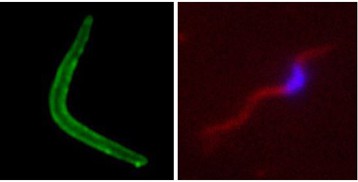
 © Nassira Mahmoudi Left: detection of the tRIP protein at the periphery of a Plasmodium parasite at the sporozoite stage (infective form present in the salivary glands of an infected mosquito). Right: detection of the entry of an exogenous tRNA (red) into a Plasmodium parasite at the sporozoite stage, whose nucleus is labeled in blue.
Scientists have just identified an Achilles heel in the parasite that causes malaria, by showing that its optimum development is dependent on its ability to expropriate RNA molecules in infected cells – a host-pathogen interaction that had never previously been observed. Although the precise function of this deviation remains mysterious, these findings open new perspectives for the targeted delivery of therapeutic agents within the parasite. This study, performed by the CNRS Architecture et Réactivité de l'ARN laboratory (Strasbourg), in collaboration with the Malaria Infection and Immunity Unit at Institut Pasteur (Paris), is published in PNAS the week of 11 April 2016. Single-cell parasites in the Plasmodium genus are the infective agents responsible for malaria and constitute one of the principal threats to human health and development in southern hemisphere countries
1. The life cycle of this parasite occurs partly in the Anopheles mosquito (digestive tract, salivary glands) and partly in humans or other mammals (liver, blood cells). During this study, the biologists identified a protein (tRip) localized on the parasite's surface and capable of of importing host tRNA into the parasite (tRNAs are key molecules involved in protein production). This is the first time that the import into cells of exogenous tRNA has been demonstrated. The scientists also demonstrated that if tRip were not present, the parasite no longer imported tRNA, its protein synthesis was reduced, and its development was markedly slowed down in the blood cells of infected mice. But what is the function of this tRNA expropriation by Plasmodium ?
TO READ THIS ARTICLE, CREATE YOUR ACCOUNT
And extend your reading, free of charge and with no commitment.
Your Benefits
- Access to all content
- Receive newsmails for news and jobs
- Post ads