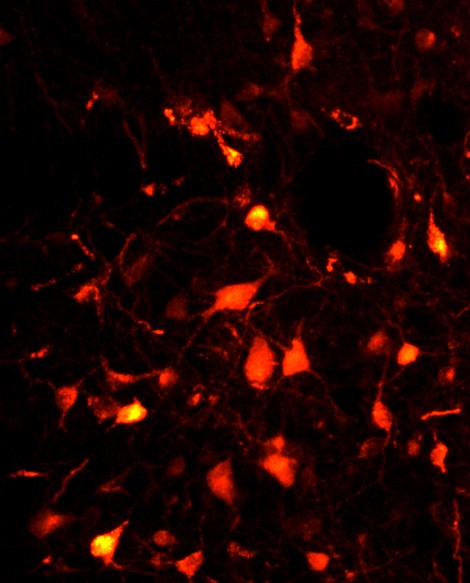
 © Sara Valencia Garcia / Patrice Fort, CNRS The glutamate neurons of the sublaterodorsal nucleus emit a spontaneous red fluorescence indicating that the viral vectors used have been successfully added.
During REM sleep, the brain inhibits the motor system, which makes the sleeper completely immobile. CNRS researchers working in the Centre de Recherche en Neurosciences de Lyon (CNRS/Université Claude Bernard Lyon 1/INSERM/Université Jean Monnet) have identified a population of neurons that is responsible for this transient muscle paralysis. The animal model created will shed light on the origin of some paradoxical sleep disorders, and more particularly the condition that prevents this paralysis. It will also be most useful in the study of Parkinson's disease, since these pathologies are related. This work was published on December 12, 2016 on the website of the journal Brain . In spite of being in a deep sleep, the patients talk, move, kick and eventually fall out of bed. They are suffering from a parasomnia called REM Sleep Behavior Disorder
1 (RBD).
TO READ THIS ARTICLE, CREATE YOUR ACCOUNT
And extend your reading, free of charge and with no commitment.
Your Benefits
- Access to all content
- Receive newsmails for news and jobs
- Post ads