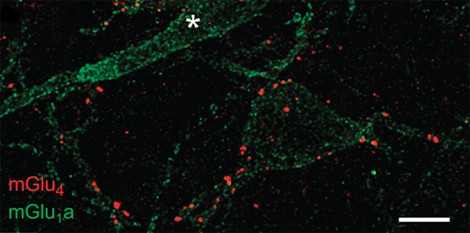
 © Zussy et al., 2016 View of synapses in the amygdala of a mouse, obtained using a confocal microscope. mGlu4 receptors in red, and mGlu1a receptors in green. The white bar bottom right corresponds to 5 μm.
Pain serves as a valuable warning signal, but when it becomes chronic, pain should be considered as a real disease. An international team including research scientists from the CNRS and INSERM
1 has identified and controlled one of the centers associated with chronic pain. This work, published on 20 December 2016 in Molecular Psychiatry , made it possible to relieve the symptoms in mice and demonstrated the ability of the brain to remedy this problem. While around 20% of the European population has experienced episodes of chronic pain, treatments are only effective in fewer than half of them. This disease is nevertheless associated with modifications to the nervous system. The scientists therefore wanted to understand how the brain modulates physical pain and the affective and cognitive disorders that accompany it: anxiety, loss of positive emotions, hypersensitivity to pain, etc. During this study, they focused on the amygdala, a brain region involved in managing pain and emotions, and on the type-4 glutamate receptor (mGlu4).
TO READ THIS ARTICLE, CREATE YOUR ACCOUNT
And extend your reading, free of charge and with no commitment.
Your Benefits
- Access to all content
- Receive newsmails for news and jobs
- Post ads