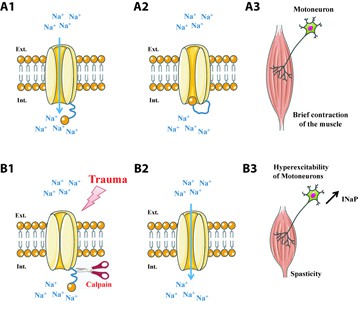
 © Frédéric Brocard / Servier Medical Art Functioning of the sodium channel of motoneurons under normal conditions (A) and pathological conditions (B).
Opening of the calcium channel triggers a current of sodium Na+ ions (A1), which is rapidly halted when a molecular loop in the protein blocks the channel pore (A2). This gives rise to brief excitation of the motoneuron, causing a short-lived muscle contraction (A3). Following a spinal cord lesion, calpain renders inactivation of this channel inoperable by inhibiting the loop responsible for its closure (B1). This results in a persistent calcium current, INaP (B2), generating prolonged excitation of the motoneuron and causing a sustained contraction of the muscle (B3).
© Frédéric Brocard / Servier Medical Art Functioning of the sodium channel of motoneurons under normal conditions (A) and pathological conditions (B).
Opening of the calcium channel triggers a current of sodium Na+ ions (A1), which is rapidly halted when a molecular loop in the protein blocks the channel pore (A2). This gives rise to brief excitation of the motoneuron, causing a short-lived muscle contraction (A3). Following a spinal cord lesion, calpain renders inactivation of this channel inoperable by inhibiting the loop responsible for its closure (B1). This results in a persistent calcium current, INaP (B2), generating prolonged excitation of the motoneuron and causing a sustained contraction of the muscle (B3).
Following spinal cord injury, most patients experience an exaggeration of muscle tone called spasticity, which frequently leads to physical disability. A team at the Institut de Neurosciences de la Timone (CNRS/Aix-Marseille Université) has just identified one of the molecular mechanisms responsible for this phenomenon. It has also proposed two therapeutic solutions that have proved conclusive in animals, one of which will be tested during phase II clinical trials as early as this year. This work, published on 14 March 2016, thus opens new therapeutic avenues to reduce this physical disability. Twelve million people throughout the world suffer from a motor disorder called spasticity. It occurs following a spinal cord lesion (traffic accidents, stroke) or in the context of neurodegenerative diseases such as amyotrophic lateral sclerosis (or Lou Gehrig's disease). Spascticity is mainly characterized by a hyperexcitability of motoneurons, the neurons in the spinal cord that control our muscle contractions.
TO READ THIS ARTICLE, CREATE YOUR ACCOUNT
And extend your reading, free of charge and with no commitment.
Your Benefits
- Access to all content
- Receive newsmails for news and jobs
- Post ads