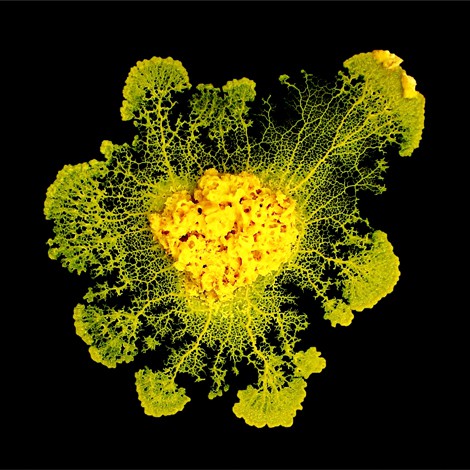
 © Audrey Dussutour (CNRS) P. polycephalum (⌀ = ~10 cm), a single-celled organism otherwise known as a slime mold, grown on agar in the laboratory.
It isn't an animal, a plant, or a fungus. The slime mold ( Physarum polycephalum ) is a strange, creeping, bloblike organism made up of one giant cell. Though it has no brain, it can learn from experience, as biologists at the Research Centre on Animal Cognition (CNRS, Université Toulouse III—Paul Sabatier) previously demonstrated.
1 Now the same team of scientists has gone a step further, proving that a slime mold can transmit what it has learned to a fellow slime mold when the two combine. These new findings are published in the December 21, 2016, issue of the Proceedings of the Royal Society B . Imagine you could temporarily fuse with someone, acquire that person's knowledge, and then split off to become your separate self again. With slime molds, that really happens! The slime mold— Physarum polycephalum for scientists—is a unicellular organism whose natural habitat is forest litter. But it can also be cultured in a laboratory petri dish.
TO READ THIS ARTICLE, CREATE YOUR ACCOUNT
And extend your reading, free of charge and with no commitment.
Your Benefits
- Access to all content
- Receive newsmails for news and jobs
- Post ads