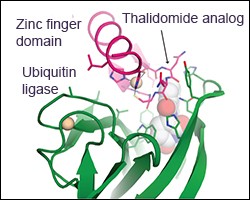
Thalidomide analogs recruit zinc finger domains of transcription factors to the CRL4-CRBN ubiquitin ligase and lead to degradation
Nicolas Thomä's group at the FMI has joined forces with the group of Benjamin Ebert at Harvard's Broad Institute to show how thalidomide analogs mediate degradation of many more proteins than previously anticipated. These proteins - zinc finger transcription factors - play a role in cancer and developmental diseases but are difficult drug targets. The new study, published in Science, suggests that thalidomide analogs can be rationally designed to target this challenging class of proteins. An "undruggable" group of proteins Most FDA-approved small molecule drugs inhibit enzymes - biology's protein machines that catalyze chemical reactions. However, many proteins in biology are not enzymes, but they nonetheless play critical roles in health and disease. Among these, transcription factors are particularly interesting drug targets because they act as the on/off switches of gene expression, processes that can cause developmental diseases and cancer when they go wrong. Until recently, transcription factors have been considered 'undruggable' because they lack catalytic active sites for drugs to bind.
TO READ THIS ARTICLE, CREATE YOUR ACCOUNT
And extend your reading, free of charge and with no commitment.