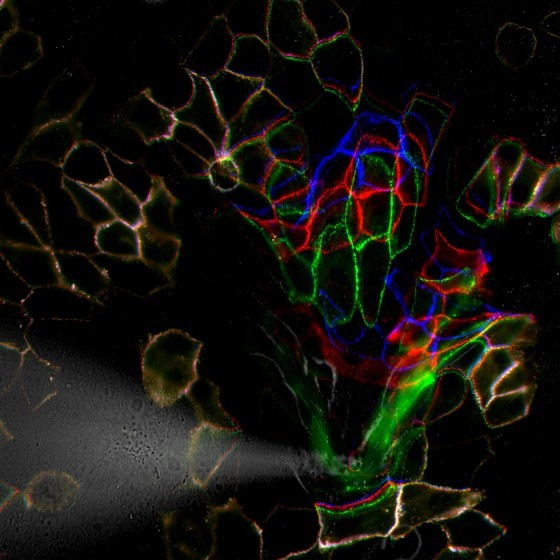
 The molecular transmission of force in desmosomes was studied before (blue), during (green) and after (red) application of mechanical stress.
The skin is our largest organ, and, among other things, it provides protection against mechanical impacts. To ensure this protection, skin cells have to be connected to one another especially closely. Exactly how this mechanical stability is provided on the molecular level was unclear for a long time. Researchers in the team led by Prof. Carsten Grashoff from the Institute of Molecular Cell Biology at the University of Münster and the Max Planck Institute of Biochemistry have been collaborating with colleagues at Ludwig Maximilian University of Munich and Stanford University in the USA, and they are now able to demonstrate how mechanical stress on specialized adhesion points, so-called desmosomes, is processed. They designed a mini-measuring device, which can determine forces along individual components of the desmosomes. In the study, published in "Nature Communications", they show how mechanical forces propagate along these structures. Cells in the skin stick together Our skin acts as a protective shield against external influences and has to withstand very different stresses.
TO READ THIS ARTICLE, CREATE YOUR ACCOUNT
And extend your reading, free of charge and with no commitment.
Your Benefits
- Access to all content
- Receive newsmails for news and jobs
- Post ads