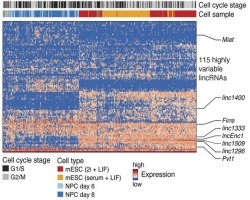
Expression of highly variable lncRNAs (rows) in single cells (columns), clustered by lncRNA expression.
Click to enlarge.
A group of researchers coordinated by Alex Tuck from Marc Bühler's lab wanted to learn more about the role of long non-protein-coding RNAs (lncRNAs); these eukaryotic RNAs lacking protein-coding potential were first described about 15 years ago, but still little is known about their biological significance. The new FMI study not only provides more clarity about the mechanisms by which lncRNAs work, it also offers new tools to further experiment with this special type of RNA - and it represents a nice example of collaboration. There are a number of open questions about lncRNAs, notably which of the thousands of lncRNA genes are functionally relevant, and whether they function as DNA elements (for example like an enhancer) or via their RNA products. The researchers around Tuck took a three-step approach to investigate these open questions, using various cutting-edge technologies. First, they profiled mouse embryonic stem cells and neural precursor cells at single-cell resolution to reveal lncRNA expression in specific cell types, cell subpopulations, or cell cycle stages; this allowed them to predict 16 of the most important lncRNA genes. For this part of the study, a collaboration with the European Bioinformatics Institute and Wellcome Trust Sanger Institute was essential for single cell RNA-sequencing and data analysis. Focusing on these 16 genes, the team then analysed their effects on gene expression - either in cis (involving neighboring genes) or in trans (involving distant, unlinked target genes) - using two different technologies: they produced cell lines in which the lncRNA genes were completely deleted, to see the effect on gene expression when the whole lncRNA gene is gone.
TO READ THIS ARTICLE, CREATE YOUR ACCOUNT
And extend your reading, free of charge and with no commitment.