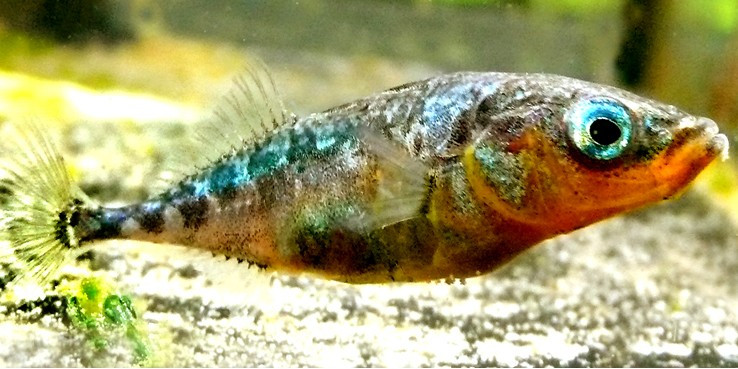
 A three-spined stickleback
A three-spined stickleback © WWU/Jörn Scharsack In order to escape predators, many fish - including insects, fish and birds - have developed strategies for rapidly transmitting information on threats to others of their species. This information is transmitted within a group of hundreds, or even thousands, of individuals in (escape) waves. This collective response is also, in the case of fish, known as shoal behaviour. Special parasites can, however, manipulate such a survival strategy. Researchers at the University of Münster have discovered that infected individual fish disturb the transmission of flight behaviour and, as a result, increase not only their own risk of being eaten, but also that of other - non-infected - members of the group. The results of the study have been published in the journal "Proceedings of the Royal Society'. Background and methodology In order to study social responsiveness in fish, the researchers used the tapeworm Schistocephalus solidus as a parasite.
TO READ THIS ARTICLE, CREATE YOUR ACCOUNT
And extend your reading, free of charge and with no commitment.
Your Benefits
- Access to all content
- Receive newsmails for news and jobs
- Post ads