An international research team led by the University of Hamburg has documented desertification in sub-Saharan Africa on an unprecedented scale. This threatens the South African Richtersveld, a globally important hotspot of biodiversity with many plants that only occur there.
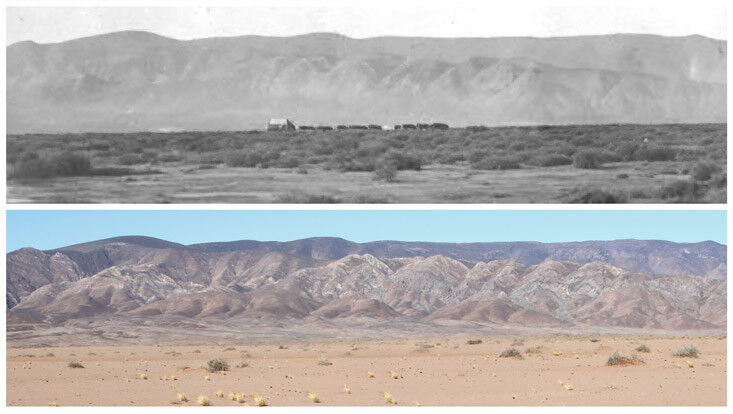
The images from South Africa are reminiscent of the devastation during the famous "Dust Bowl" in the Midwest of the USA, which was one of the causes of the Great Depression in the 1930s: Formerly valuable pastureland is buried under sand, abandoned farmhouses buried by dunes. Now most areas of South Africa’s Richtersveld are experiencing a sometimes dramatic decline in vegetation and biodiversity. This has been established by a botanist and a soil scientist from the University of Hamburg together with colleagues from South Africa and Namibia on the basis of data dating back up to 45 years. That is how long they have been monitoring the area, which at 10,000 square kilometers is about half the size of Hesse.
Together, the researchers have analyzed the composition and quantity of plant species in defined monitoring areas at regular intervals, evaluated time series of satellite images - and this year recreated photos that were taken in 1914.
"At first, it seemed as if the vegetation would always return resiliently to its original state despite all the fluctuations. However, we have now discovered that the creeping impoverishment of the plant world began decades ago and continued even after the end of the most recent, extreme drought period, which lasted a full ten years from 2012 to 2022," explains Norbert Jürgens. The emeritus biologist from the University of Hamburg has been conducting research in the area since 1980. Since 1992, he has been investigating the changes in the soil together with soil scientist Dr. Alexander Gröngröft, also a scientist at the University of Hamburg and co-author of the study.
The researchers have discovered that the loss of species always occurs in similar stages. First, formerly densely vegetated grasslands lose the ecologically most important species: long-lived, water-storing dwarf shrubs that cover the ground and can hold on to sand and dust transported by the wind. Subsequently, sparsely growing, salt-loving plant species replace the succulents, which are crucial for the ecosystem. And because the subsequent vegetation cannot permanently protect the soil surface, the fertile part of the soil is carried away by the wind, resulting in vegetation-free sandy areas that are hardly colonized even after rainfall. The change in soil properties becomes a tipping point for the change in biodiversity.
Of the estimated 1000 endemic plant species that only occur in the Richtersveld worldwide, more than 400 are considered endangered. This is estimated by another co-author of the study, Pieter van Wyk, curator of the South African research garden "Richtersveld Desert Botanical Garden". By comparison, far fewer than 100 endemic plant species are known in the whole of Germany.
The researchers see the causes of desertification partly in climate change, which is damaging the plants with higher temperatures, higher wind speeds and longer periods of drought. However, they have also discovered that local people are contributing greatly to the advance of the desert, which is unique in the world. This is because mining companies that mine for diamonds usually leave open-cast mining sites open, which mobilizes large quantities of sand. In the wind, the transported grains of sand act like a sandblast, damaging the vegetation and burying it. Temporary overgrazing by goats, sheep and cattle also triggers the transportation of sand and dust.
in some areas, the combination of drought, overgrazing and frequent strong wind events has already led to an irreversible change in soil properties in this sensitive and globally unique ecosystem," says Prof. Jürgens. The change in the soil due to erosion can be observed particularly in the north of the area, where succulent shrubs have been replaced by sparse desert grasses. In the south and west, more than 400 square kilometers are buried under sand - an area four times the size of the island of Sylt.
To combat desertification, the scientists propose a package of measures, including strict control of mines and limiting grazing. Particularly vulnerable regions should be placed under nature conservation - without any land use or off-road access. These rules should also apply to the numerous projects planned in the region to generate renewable energy from photovoltaics and wind, they demand. Even if these are considered green investments in the global North, they could - depending on the planning - cause further devastation or contribute to the renaturation of the area.
Link to the original publication: https://authors.elsevier.com/sd/article/S0140-1963(25)00143-0
Innovating and Cooperating for a Sustainable Future in a Digital AgeUniversity of Hamburg