



Chemistry - Mar 19
Leipzig University and Center for the Transformation of Chemistry conclude collaboration agreement
Leipzig University and Center for the Transformation of Chemistry conclude collaboration agreement


Chemistry - Feb 2
New material for use in the chemical industry capable of transforming CO2 into high value-added compounds
New material for use in the chemical industry capable of transforming CO2 into high value-added compounds
Chemistry - Feb 2
Material for modulating metal-organic frameworks for use in the chemical industry capable of transforming CO2 into high value-added compounds
Material for modulating metal-organic frameworks for use in the chemical industry capable of transforming CO2 into high value-added compounds
Chemistry - Jan 15
University of Glasgow spin-out hails milestone breakthrough in hydrogen energy process
University of Glasgow spin-out hails milestone breakthrough in hydrogen energy process
Life Sciences - Dec 17
Manchester Institute of Biotechnology welcomes three new professors, driving innovation in chemical and biological sciences
Manchester Institute of Biotechnology welcomes three new professors, driving innovation in chemical and biological sciences

Health - Nov 21
New Collaborative Research Centres: A Resounding Success for the University and the University Hospital
New Collaborative Research Centres: A Resounding Success for the University and the University Hospital
Chemistry - Nov 6
The scientific community and industry are seeking ways to accelerate the application of perovskite solar cells
The scientific community and industry are seeking ways to accelerate the application of perovskite solar cells
news
Chemistry
Results 3421 - 3440 of 3959.
Chemistry - Life Sciences - 22.11.2012
Key pathological mechanism found in plague bacterium
from Umeå University A more than 50-year-old question has now been answered. Chemists and microbiologists at the Biological Chemistry Center at Umeå University in Sweden are now able to describe in detail the role of calcium in the ability of the plague bacterium Yersinias to cause disease. In the 14th century, the Black Death claimed the lives of one third of the population of Europe.
Physics - Chemistry - 22.11.2012

Researchers have elucidated a century-old mystery: how hydrogen destroys steels. A new mathematical model predicts this failure in the presence of the destructive atoms. A veritable gangrene for steels and other structural metals, hydrogen is one of the most important causes of ruptures in industrial parts, such as pipelines.
Chemistry - Physics - 20.11.2012

Scientists at Imperial College London have developed a system to quickly detect trace amounts of chemicals like pollutants, explosives or illegal drugs. The new system can pick out a single target molecule from 10 000 trillion water molecules within milliseconds, by trapping it on a self-assembling single layer of gold nanoparticles.
Life Sciences - Chemistry - 15.11.2012

Passing one's genes on to the next generation is a mark of evolutionary success. So it makes sense that the body would work to ensure that the genes the next generation inherits are exact replicas of the originals. New research by biologists at the University of Pennsylvania School of Veterinary Medicine has now identified one way the body does exactly that.
Health - Chemistry - 09.11.2012
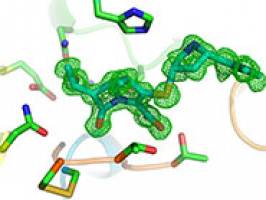
Scientists at the University of Bristol, together with collaborators at the University of Aveiro, Portugal, have solved the structure of an enzyme that breaks down carbapenems , antibiotics 'of last resort' which, until recently, were kept in reserve for serious infections that failed to respond to other treatments.
Chemistry - Physics - 09.11.2012

The prospect of creating clean, renewable hydrogen fuel is closer than ever after a breakthrough in our understanding of photosynthesis. Professors Rob Stranger and Ron Pace from the Research School of Chemistry in the ANU College of Physical and Mathematical Sciences used computer modelling to reveal the molecular structure of the photosynthesis reaction site in plants.
Chemistry - Environment - 07.11.2012

A long-abandoned fermentation process once used to turn starch into explosives can be used to produce renewable diesel fuel to replace the fossil fuels now used in transportation, University of California, Berkeley, scientists have discovered. Campus chemists and chemical engineers teamed up to produce diesel fuel from the products of a bacterial fermentation discovered nearly 100 years ago by the first president of Israel, chemist Chaim Weizmann.
Chemistry - Physics - 07.11.2012
First ’snapshots’ of the electronic structure of a manganese complex related to water-splitting in photosynthesis
from Umeå University Together with a large international research team, Johannes Messinger of Umeå University in Sweden has taken another step toward an understanding of photosynthesis and developing artificial photosynthesis. With a combination of a x-ray free-electron laser and spectroscopy, the team has managed to see the electronic structure of a manganese complex, a chemical compound related to how photosynthesis splits water.
Chemistry - Physics - 06.11.2012
In static friction, chemistry is key to stronger bonds
Inspired by phenomena common to both earthquakes and atomic force microscopy, materials engineers have learned that chemical reactions between two silicon dioxide surfaces cause the bonds at that interface to "age," or strengthen gradually over time. In researchers' understanding of static friction, it's an advance with staying power.
Chemistry - Life Sciences - 05.11.2012
A step toward stronger polymers
Counting loops that weaken materials could help researchers eliminate structural flaws. Many of the objects we encounter are made of polymers - long chains of repeating molecules. Networks of polymers form manmade materials such as plastics, as well as natural products such as rubber and cellulose. Within all of these polymeric materials, there are structural flaws at the molecular level.
Physics - Chemistry - 30.10.2012

Materials scientists have developed a simple, robust way to fabricate carbon-free and polymer-free, lightweight colloidal films for lithium-ion battery electrodes, which could greatly improve battery performance. By developing a method for additive-free electrodes that maintain high conductivity, the researchers have opened new possibilities for reducing the weight and volume of batteries, while also creating a template system for studying the physics of nanoparticle electrodes.
Life Sciences - Chemistry - 26.10.2012
Metals in the genetic forge: detailed views of RNA splicing
Scientists at Yale University have described in the greatest detail yet aspects of the chemical processes by which RNA carries out the expression of our genes. In a paper published Oct. 26 in the journal Cell, researchers report 14 crystal structures for a group II intron - an enzyme involved in RNA splicing, a critical phase of genetic reproduction.
Health - Chemistry - 26.10.2012

The disease atherosclerosis involves the build up of fatty tissue within arterial walls, creating unstable structures known as plaques. These plaques grow until they burst, rupturing the wall and causing the formation of a blood clot within the artery. These clots also grow until they block blood flow; in the case of the coronary artery, this can cause a heart attack.
Life Sciences - Chemistry - 26.10.2012
Laser spotlight reveals machine 'climbing' DNA
New imaging technology has revealed how the molecular machines that remodel genetic material inside cells 'grab onto' DNA like a rock climber looking for a handhold. The experiments, reported in this week's Science , use laser light to generate very bright patches close to single cells. When coupled with fluorescent tags this 'spotlight' makes it possible to image the inner workings of cells fast enough to see how the molecular machines inside change size, shape, and composition in the presence of DNA.
Physics - Chemistry - 24.10.2012
Electron 'sniper' targets graphene
Because of its intriguing properties graphene could be the ideal material for building new kinds of electronic devices such as sensors, screens, or even quantum computers. One of the keys to exploiting graphene's potential is being able to create atomic-scale defects - where carbon atoms in its flat, honeycomb-like structure are rearranged or 'knocked out' - as these influence its electrical, chemical, magnetic, and mechanical properties.
Chemistry - Health - 24.10.2012
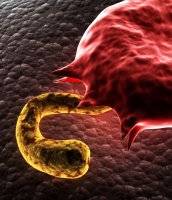
Researchers have identified a new means to eradicate malaria infections by rapidly killing the blood-borne Plasmodium parasites that cause the disease. Malaria causes up to 3 million deaths each year, predominantly afflicting vulnerable people such as children under five and pregnant women, in tropical regions of Africa, Asia, and Latin America.
Chemistry - Physics - 23.10.2012
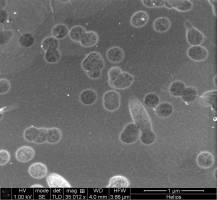
New membranes may filter water or separate biological samples. Much has been made of graphene's exceptional qualities, from its ability to conduct heat and electricity better than any other material to its unparalleled strength: Worked into a composite material, graphene can repel bullets better than Kevlar.
Life Sciences - Chemistry - 21.10.2012
A new glow for electron microscopy
Protein-labeling technique allows high-resolution visualization of molecules inside cells. The glowing green molecule known as green fluorescent protein (GFP) has revolutionized molecular biology. When GFP is attached to a particular protein inside a cell, scientists can easily identify and locate it using fluorescence microscopy.
Health - Chemistry - 18.10.2012
Scientists harness immune system to prevent lymphoma relapse
18 Oct 2012 The University of Manchester researchers, who were funded by the charities Leukaemia & Lymphoma Research and Cancer Research UK, have shown that, when used in conjunction with radiotherapy, the new drug is potentially four times more likely to lead to long-term survival than radiotherapy alone.
Astronomy & Space - Chemistry - 18.10.2012

Radioactive decay of titanium powers supernova remnant The first direct detection of radioactive titanium associated with supernova remnant 1987A has been made by ESA's Integral space observatory. The radioactive decay has likely been powering the glowing remnant around the exploded star for the last 20 years.


Chemistry - Mar 19
Leipzig University and Center for the Transformation of Chemistry conclude collaboration agreement
Leipzig University and Center for the Transformation of Chemistry conclude collaboration agreement
Chemistry - Feb 2
New material for use in the chemical industry capable of transforming CO2 into high value-added compounds
New material for use in the chemical industry capable of transforming CO2 into high value-added compounds
Chemistry - Feb 2
Material for modulating metal-organic frameworks for use in the chemical industry capable of transforming CO2 into high value-added compounds
Material for modulating metal-organic frameworks for use in the chemical industry capable of transforming CO2 into high value-added compounds
Chemistry - Jan 15
University of Glasgow spin-out hails milestone breakthrough in hydrogen energy process
University of Glasgow spin-out hails milestone breakthrough in hydrogen energy process
Life Sciences - Dec 17
Manchester Institute of Biotechnology welcomes three new professors, driving innovation in chemical and biological sciences
Manchester Institute of Biotechnology welcomes three new professors, driving innovation in chemical and biological sciences
Health - Nov 21
New Collaborative Research Centres: A Resounding Success for the University and the University Hospital
New Collaborative Research Centres: A Resounding Success for the University and the University Hospital
Chemistry - Nov 6
The scientific community and industry are seeking ways to accelerate the application of perovskite solar cells
The scientific community and industry are seeking ways to accelerate the application of perovskite solar cells