


Health - Today
Intratumoural microbiota and the immune system: a new study from the EOC-USI Institute for Translational Research
Intratumoural microbiota and the immune system: a new study from the EOC-USI Institute for Translational Research



Event - Mar 17
CEA Leti to Showcase Integrated Expertise In Microelectronics Reliability at IRPS 2026
CEA Leti to Showcase Integrated Expertise In Microelectronics Reliability at IRPS 2026

Health - Mar 17
AI was supposed to ease doctors' workload - instead they spend hours correcting errors
AI was supposed to ease doctors' workload - instead they spend hours correcting errors



Pharmacology - Mar 17
International trial finds rapid diagnostic testing alone does not reduce antibiotic prescribing for respiratory infections
International trial finds rapid diagnostic testing alone does not reduce antibiotic prescribing for respiratory infections

Social Sciences - Mar 17
Social background shapes how hard children work, according to a study by UC3M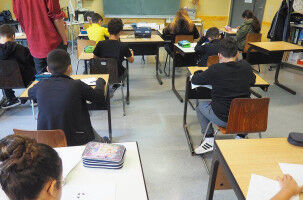
Social background shapes how hard children work, according to a study by UC3M


news
Electroengineering
Results 661 - 680 of 763.
Physics - Electroengineering - 12.06.2013

ANN ARBOR-In findings that could help overcome a major technological hurdle in the road toward smaller and more powerful electronics, an international research team involving University of Michigan engineering researchers, has shown the unique ways in which heat dissipates at the tiniest scales. A paper on When a current passes through a material that conducts electricity, it generates heat.
Electroengineering - Physics - 12.06.2013

12 Jun 2013 Wonder material graphene can be made magnetic and its magnetism switched on and off at the press of a button, opening a new avenue towards electronics with very low energy consumption. In a report published in Nature , a University of Manchester team led by Dr Irina Grigorieva shows how to create elementary magnetic moments in graphene and then switch them on and off.
Electroengineering - Physics - 07.06.2013
Plastic electronics made easy
Scientists have discovered a way to better exploit a process that could revolutionise the way that electronic products are made. The scientists from Imperial College London say improving the industrial process, which is called crystallisation, could revolutionise the way we produce electronic products, leading to advances across a whole range of fields; including reducing the cost and improving the design of plastic solar cells (see pull-out box).
Physics - Electroengineering - 05.06.2013

Advances would boost security screening systems, infrared thermal cameras, energy harvesting, and radar systems This development is a key step toward replacing bulky conventional optics with flexible sheets that are about the thickness of a human hair and weighing a fraction of an ounce.
Electroengineering - Chemistry - 04.06.2013

Stanford scientists have developed inexpensive silicon-based electrodes that dramatically improve the charge storage capacity of lithium-ion batteries. Stanford University scientists have dramatically improved the performance of lithium-ion batteries by creating novel electrodes made of silicon and conducting polymer hydrogel, a spongy substance similar to the material used in soft lenses and other household products.
Life Sciences - Electroengineering - 17.05.2013
Electrical boost to mental arithmetic powers
A weak electrical signal can boost people's powers of mental arithmetic over a period of months, suggests a small scale study at the University of Oxford. The technique involves placing electrodes on the scalp of the head and applying random electrical noise to stimulate parts of the brain and encourage nerve cells to fire.
Physics - Electroengineering - 16.05.2013
Stacking 2-D materials produces surprising results
New experiments reveal previously unseen effects, could lead to new kinds of electronics and optical devices. Graphene has dazzled scientists, ever since its discovery more than a decade ago, with its unequalled electronic properties, its strength and its light weight. But one long-sought goal has proved elusive: how to engineer into graphene a property called a band gap, which would be necessary to use the material to make transistors and other electronic devices.
Life Sciences - Electroengineering - 15.05.2013
Evolution shapes new rules for ant behavior, Stanford research finds
Biologist Deborah M. Gordon's decades-long study of the collective behavior of harvester ant colonies has provided a rare real-time look at natural selection at work. In ancient Greece, the city-states that waited until their own harvest was in before attacking and destroying a rival community's crops often experienced better long-term success.
Physics - Electroengineering - 13.05.2013
Graphene joins the race to redefine the ampere
A new joint innovation by the University of Cambridge and the National Physical Laboratory (NPL), the UK's National Measurement Institute, could pave the way for redefining the ampere in terms of fundamental constants of physics. Graphene is constantly revealing exciting new applications and as our understanding of the material advances rapidly, we seem able to do more and more with it Malcolm Connolly The world's first graphene single-electron pump (SEP), described in a paper , provides the speed of electron flow needed to create a new standard for electrical current based on electron charge.
Physics - Electroengineering - 09.05.2013

Scientists at the University of Liverpool have shown that some atomic nuclei can assume the shape of a pear which contributes to our understanding of nuclear structure and the underlying fundamental interactions. Most nuclei that exist naturally are not spherical but have the shape of a rugby ball. While state-of-the-art theories are able to predict this, the same theories have predicted that for some particular combinations of protons and neutrons, nuclei can also assume very asymmetric shapes, like a pear where there is more mass at one end of the nucleus than the other.
Electroengineering - Physics - 22.04.2013

Imagine how much you could save on your electricity bill if you could use the excess heat your computer generates to actually power the machine. Researchers at the UCLA Henry Samueli School of Engineering and Applied Science have taken an important step toward harnessing that heat and converting it for practical use.
Education - Electroengineering - 11.04.2013
From cloud formation to liquid foundation: new soft matter model developed
Imperial researchers develop model to more accurately describe the motion of soft matter particles. Chemical engineers and mathematicians from Imperial College London have put their heads together to create a new model that more accurately describes the motion of soft matter particles. Ben Goddard, a research associate who works with Professor Serafim Kalliadasis in the Department of Chemical Engineering, sat down to talk about soft matter materials, such as paints and sponges, and how their model can be applied in fields ranging from nanotechnology to environmental science.
Innovation - Electroengineering - 10.04.2013
Aircraft Sensors without Batteries or Cables
An idea from EADS and Vienna University of Technology is taking off: in a joint project, Energy Harvester Modules suitable for aircrafts have been tested, which should supply sensor nodes with electrical power in the future. Like a nervous system in a human body, sensor networks attached to the aircraft fuselage will in future record and transmit essential data concerning the structural health of the aircraft.
Mechanical Engineering - Electroengineering - 02.04.2013

Academics have demonstrated for the first time that a "sonic lasso" can be used to grip microscopic objects, such as cells, and move them about. The research by academics at the University of Bristol's Department of Mechanical Engineering and the University of Dundee's Institute for Medical Science and Technology is published online in Applied Physics Letters .
Electroengineering - Mechanical Engineering - 27.03.2013
Research leads towards new standard tests for tennis courts
Tennis players can adapt their movement/playing style in response to subtle differences in court constructions, according to new research by engineers at the University of Sheffield. The findings - published online in the Journal of Sports Engineering and Technology - are the first steps towards setting international standards to characterise the interaction between shoes and surfaces.
Earth Sciences - Electroengineering - 27.03.2013
Scripps Scientists Image Deep Magma beneath Pacific Seafloor Volcano
Vast mantle melting region below world's largest volcanic system advances theory of plate tectonics Since the plate tectonics revolution of the 1960s, scientists have known that new seafloor is created throughout the major ocean basins at linear chains of volcanoes known as mid-ocean ridges. But where exactly does the erupted magma come from? During a 2004 expedition aboard R/V Roger Revelle, researchers deployed an electromagnetic instrument off Central America.
Electroengineering - Physics - 26.03.2013
Researchers Create an Ultrathin Invisibility Cloak
AUSTIN, Texas — Until now, the invisibility cloaks put forward by scientists have been bulky devices - an obvious flaw for those interested in Harry Potter-style applications. However, researchers at The University of Texas at Austin have developed a cloak that is just micrometers thick and can hide three-dimensional objects from microwaves in their natural environment, in all directions and from all of the observers' positions.
Physics - Electroengineering - 21.03.2013

Researchers with the U.S. Department of Energy (DOE)'s Lawrence Berkeley National Laboratory (Berkeley Lab) have once again demonstrated the incredible capabilities of metamaterials - artificial nanoconstructs whose optical properties arise from their physical structure rather than their chemical composition.
Electroengineering - 08.03.2013
Small differences in how a technology is defined can make a big difference in how the public feels about it
Even small tweaks in how scientists describe scientific breakthroughs can significantly change how the public perceives their work, a new study indicates. Researchers found that showing individuals different definitions of nanotechnology led to differences in how strongly the subjects supported this emerging area of science and in their motivation to learn more about it.
Physics - Electroengineering - 07.03.2013
New technique makes solar cells more efficient
A new technique developed by University of Toronto Engineering Professor Ted Sargent and his research group could lead to significantly more efficient solar cells. In a paper published in the journal Nano Letters , the group describes a new technique to improve efficiency in what are called colloidal quantum dot photovoltaics.


Health - Today
Intratumoural microbiota and the immune system: a new study from the EOC-USI Institute for Translational Research
Intratumoural microbiota and the immune system: a new study from the EOC-USI Institute for Translational Research
Event - Mar 17
CEA Leti to Showcase Integrated Expertise In Microelectronics Reliability at IRPS 2026
CEA Leti to Showcase Integrated Expertise In Microelectronics Reliability at IRPS 2026
Health - Mar 17
AI was supposed to ease doctors' workload - instead they spend hours correcting errors
AI was supposed to ease doctors' workload - instead they spend hours correcting errors
Pharmacology - Mar 17
International trial finds rapid diagnostic testing alone does not reduce antibiotic prescribing for respiratory infections
International trial finds rapid diagnostic testing alone does not reduce antibiotic prescribing for respiratory infections
Social Sciences - Mar 17
Social background shapes how hard children work, according to a study by UC3M
Social background shapes how hard children work, according to a study by UC3M