



Event - Mar 17
CEA Leti to Showcase Integrated Expertise In Microelectronics Reliability at IRPS 2026
CEA Leti to Showcase Integrated Expertise In Microelectronics Reliability at IRPS 2026

Health - Mar 17
AI was supposed to ease doctors' workload - instead they spend hours correcting errors
AI was supposed to ease doctors' workload - instead they spend hours correcting errors




Pharmacology - Mar 17
International trial finds rapid diagnostic testing alone does not reduce antibiotic prescribing for respiratory infections
International trial finds rapid diagnostic testing alone does not reduce antibiotic prescribing for respiratory infections

Social Sciences - Mar 17
Social background shapes how hard children work, according to a study by UC3M
Social background shapes how hard children work, according to a study by UC3M
Innovation - Mar 17
With Robotics Innovation Center, CMU and Hazelwood Partners Sustain Community Collaborations
With Robotics Innovation Center, CMU and Hazelwood Partners Sustain Community Collaborations





news
History & Archeology
Results 641 - 660 of 979.
Health - History & Archeology - 22.07.2016
Ancient faeces provides earliest evidence of infectious disease being carried on Silk Road
Intestinal parasites as well as goods were carried by travellers on iconic route, say researchers examining ancient latrine. This proves for the first time that travellers along the Silk Road really were responsible for the spread of infectious disease along this route in the past Piers Mitchell An ancient latrine near a desert in north-western China has revealed the first archaeological evidence that travellers along the Silk Road were responsible for the spread of infectious diseases along huge distances of the route 2,000 years ago.
History & Archeology - Life Sciences - 08.07.2016
Monkeys in Brazil have used stone tools for hundreds of years at least
New archaeological evidence suggests that Brazilian capuchins have been using stone tools to crack open cashew nuts for at least 700 years, and the new research paper asks whether human behaviour was influenced through watching the monkeys. Researchers say, to date, they have found the earliest archaeological examples of monkey tool use outside of Africa.
Environment - History & Archeology - 07.07.2016
Innovation of Stone Age humans ’not linked with climate change’
The cultural and technological innovations of Middle Stone Age humans in Southern Africa may not be directly linked to climate, according to new research. Environmental records obtained from archaeological sites where there are Middle Stone Age deposits are the subject of the study published in the journal, PLOS ONE .
History & Archeology - Social Sciences - 06.07.2016
Sailors leave ancient fingerprints across Polynesia
A long-standing debate on the colonisation process of Oceania has been put to rest with new research finding Polynesia was deliberately settled in one of the greatest maritime migrations in human history. The University of Queensland research used chemical fingerprinting on stone tools to show sailors travelled throughout the Polynesian islands for several centuries after colonisation.
History & Archeology - 05.07.2016
Evidence points to Lindisfarne’s earliest monastery
Archaeologists from Durham University and the crowd-funded archaeology platform DigVentures have found what they believe to be evidence of the earliest monastery on Lindisfarne. During an archaeological dig on the Holy Island in June a rare Anglo Saxon grave marker was found. Ancient name stone The small, round-headed sandstone marker, commonly known as a name stone, has been dated to the mid-7 th to 8 th Century AD, well within the period of Lindisfarne's first monastery.
History & Archeology - Life Sciences - 09.06.2016
Generations of macaques used ’tools’ to open their oysters and nuts
A new study looks into the history of stone tools used by wild macaques in coastal Thailand. It finds they have been using them for decades..and possibly thousands of years.. to crack open shellfish and nuts. While there have been several studies observing living non-human primates, this is the first report into the archaeological evidence of tool use by Old World monkeys.
Environment - History & Archeology - 07.06.2016
’Pristine’ landscapes haven’t existed for thousands of years
'Pristine' landscapes simply do not exist anywhere in the world today and, in most cases, have not existed for at least several thousand years, says a new study led by the University of Oxford. An exhaustive review of archaeological data from the last 30 years details how the world's landscapes have been shaped by repeated human activity over many thousands of years.
Life Sciences - History & Archeology - 02.06.2016
Genetic switch that turned moths black also colours butterflies
Heliconius butterflies have evolved bright yellow colours to deter predators, while peppered moths famously turned black to hide from birds. A new study reveals that the same gene causes both, raising fascinating questions about how evolution by natural selection occurs in these species. It raises the question that given the diversity in butterflies and moths, and the hundreds of genes involved in making a wing, why is it this one every time?
History & Archeology - 01.06.2016
Archaeologists studying the distribution of ancient rice believe they may be close to solving one of the enduring mysteries of the ancient world - how people of South East Asian origin ended up living on the African island of Madagascar, 6,000 km away. Teams from the universities of Bristol, Oxford and Queensland excavated 18 sites in Madagascar, Comoros, and along the East African coast and recovered over 2,500 seed remains.
Life Sciences - History & Archeology - 01.06.2016
Dogs were domesticated not once, but twice... in different parts of the world
The question, 'Where do domestic dogs come from?', has vexed scholars for a very long time. Some argue that humans first domesticated wolves in Europe, while others claim this happened in Central Asia or China. A new paper suggests that all these claims may be right.
History & Archeology - 31.05.2016
Crop remains point to surprising early colonisers of Madagascar
Researchers have helped solve one of the enduring mysteries of the ancient world: why the inhabitants of Madagascar speak Malagasy, a language otherwise unique to Southeast Asia and the Pacific - a region located at least 6,000 km away. An international research team has identified that ancient crop remains excavated from sites in Madagascar consist of Asian species like rice and mung beans: the first archaeological evidence that settlers from South Asia are likely to have colonised the island over a thousand years ago.
Computer Science - History & Archeology - 30.05.2016
Completely ordinary photos are being transformed into clean, high-resolution 3D worlds thanks to algorithms from TU Wien.
History & Archeology - 30.05.2016
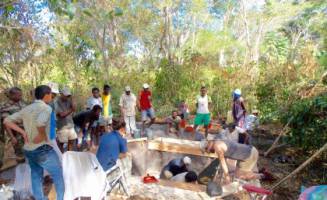
Remnants of ancient crops have provided researchers with clues that could help map the movement of humans across the globe more than 1300 years ago. The University of Queensland-led international study has uncovered the first direct archaeological evidence that Madagascar was colonised by a Southeast Asian community.
Life Sciences - History & Archeology - 27.05.2016
Great Migration and African-American genomic diversity
A new study of genomic diversity in the U.S. clarifies the role of pre-Civil War admixture and early 20th century transit routes in shaping the migration history and genomic diversity among African-American communities. The research by McGill University professor Simon Gravel and colleagues, was published May 27 in PLOS Genetics.
History & Archeology - 27.05.2016
No 181 from May 27, 2016 Global Intellectual History - Transfer, Circulation of Ideas, and Actors in the 18th to 20th Centuries German Research Foundation Funds New Research Training Group at Freie Universität Berlin
German Research Foundation Funds New Research Training Group at Freie Universität Berlin No 181/2016 from May 27, 2016 The German Research Foundation (DFG) has agreed to fund the establishment of a new Research Training Group at Freie Universität Berlin. Within the new group, entitled Global "Intellectual History - Transfer, Circulation of Ideas, Major Players (18th to 20th Centuries)," scholars will address intellectual responses to integration processes, the emergence of cross-border claims, and the universalization of ideas, as well as counter-movements.
Environment - History & Archeology - 25.05.2016
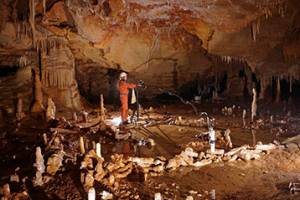
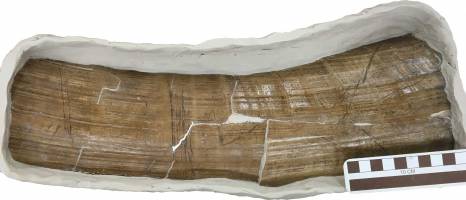
Deep inside Bruniquel Cave, in the Tarn et Garonne region of southwestern France, a set of man-made structures 1 336 meters from the entrance was recently dated as being approximately 176,500 years old.
History & Archeology - Earth Sciences - 20.05.2016
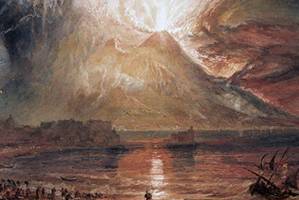
View of the eruption of Vesuvius in 79 AD, from the bay of Naples, as imagined by the artist William Turner between 1817 and 1820 Almost two thousand years after the eruption of Vesuvius that destroyed Pompeii and Herculaneum, certain periods of the history of Naples have just been reconstructed. Until now, historians and archaeologists had wondered about the impact of this volcanic eruption on the Aqua Augusta aqueduct which supplied Naples and neighboring cities with water.
Earth Sciences - History & Archeology - 16.05.2016
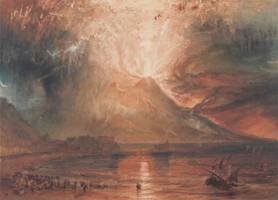
Almost two thousand years after the eruption of Vesuvius that destroyed Pompeii and Herculaneum, certain periods of the history of Naples have just been reconstructed. Until now, historians and archaeologists had wondered about the impact of this volcanic eruption on the Aqua Augusta aqueduct which supplied Naples and neighboring cities with water.
History & Archeology - 13.05.2016
ANN ARBOR-The discovery of stone tools found in a Florida river show that humans settled the southeastern United States far earlier than previously believed-perhaps by as much as 1,500 years, according to a team of scientists that includes a University of Michigan paleontologist.
History & Archeology - 13.05.2016

Artisanal interpretation of ceramics from the Bronze Age shows that a nine-year-old child could be a highly skilled artisan. This was one of the discoveries presented in a new thesis from Lund University. The thesis explores how an artisanal perspective can contribute to archaeology by providing new insights into archaeological artefacts.


Event - Mar 17
CEA Leti to Showcase Integrated Expertise In Microelectronics Reliability at IRPS 2026
CEA Leti to Showcase Integrated Expertise In Microelectronics Reliability at IRPS 2026
Health - Mar 17
AI was supposed to ease doctors' workload - instead they spend hours correcting errors
AI was supposed to ease doctors' workload - instead they spend hours correcting errors
Pharmacology - Mar 17
International trial finds rapid diagnostic testing alone does not reduce antibiotic prescribing for respiratory infections
International trial finds rapid diagnostic testing alone does not reduce antibiotic prescribing for respiratory infections
Social Sciences - Mar 17
Social background shapes how hard children work, according to a study by UC3M
Social background shapes how hard children work, according to a study by UC3M
Innovation - Mar 17
With Robotics Innovation Center, CMU and Hazelwood Partners Sustain Community Collaborations
With Robotics Innovation Center, CMU and Hazelwood Partners Sustain Community Collaborations