




Health - Today
AI was supposed to ease doctors' workload - instead they spend hours correcting errors
AI was supposed to ease doctors' workload - instead they spend hours correcting errors


Pharmacology - Today
International trial finds rapid diagnostic testing alone does not reduce antibiotic prescribing for respiratory infections
International trial finds rapid diagnostic testing alone does not reduce antibiotic prescribing for respiratory infections

Social Sciences - Today
Social background shapes how hard children work, according to a study by UC3M
Social background shapes how hard children work, according to a study by UC3M
Innovation - Today
With Robotics Innovation Center, CMU and Hazelwood Partners Sustain Community Collaborations
With Robotics Innovation Center, CMU and Hazelwood Partners Sustain Community Collaborations




news
History & Archeology
Results 761 - 780 of 979.
Linguistics & Literature - History & Archeology - 20.09.2013
Buried Roman theatre sets the stage for new understanding of ancient town
Architectural remains from a Roman theatre buried beneath the Italian countryside are providing new clues as to the importance of a town abandoned by civilisation 1,500 years ago.
Life Sciences - History & Archeology - 10.09.2013
Unique fossil of marine lizard discovered
An ancient marine lizard in remarkable condition has been uncovered by a Lund University-led research team in Jordan. Its fish-like tail fin tells an evolutionary story about the species previously unknown to scientists. One of history's most fearsome predators, the mosasaur Prognathodon , lived during the Cretaceous Period some 70 million years ago.
History & Archeology - 04.09.2013
Researchers pinpoint when the first kings ruled Egypt
A team of scientists and archaeologists, including UCL's Professor David Wengrow and Dr Alice Stevenson, have been able to set a robust timeline for the first eight dynastic rulers of ancient Egypt. The study, which is published in the journal Proceedings of the Royal Society A, shows that Egypt formed far more rapidly than was previously thought and also updates the techniques first developed by Flinders Petrie over 100 years ago,.
History & Archeology - Mathematics - 04.09.2013
Pinpointing when the First Dynasty of Kings ruled Egypt
For the first time, a team of scientists and archaeologists has been able to set a robust timeline for the first eight dynastic rulers of Egypt. Until now there have been no verifiable chronological records for this period or the process leading up to the formation of the Egyptian state. The chronology of Early Egypt between 4500 and 2800 BC has been reset by building mathematical models that combine new radiocarbon dates with established archaeological evidence.
History & Archeology - 02.09.2013
Declassified spy photographs reveal lost Roman frontier
Declassified spy photography has uncovered a lost Roman Eastern frontier, dating from the second century AD. Research by archaeologists at the Universities of Glasgow and Exeter has identified a long wall that ran 60 kilometers from the Danube to the Black Sea over what is modern Romania. It is considered the most easterly example of a man-made frontier barrier system in the Roman Empire.
Life Sciences - History & Archeology - 27.08.2013
European hunter-gatherers owned pigs as early as 4600BC
We use cookies to ensure that we give you the best experience on our website. You can change your cookie settings at any time. Otherwise, we'll assume you're OK to continue. European hunter-gatherers owned pigs as early as 4600BC European hunter-gatherers acquired domesticated pigs from nearby farmers as early as 4600BC, according to new evidence.
History & Archeology - 20.08.2013
The Vikings were not the first colonisers of the Faroe Islands
The Faroe Islands were colonised much earlier than previously believed, and it wasn't by the Vikings, according to new research. New archaeological evidence places human colonisation in the 4 th to 6 th centuries AD, at least 300-500 years earlier than previously demonstrated. The research, directed by Dr Mike J Church from Durham University and Símun V Arge from the National Museum of the Faroe Islands as part of the multidisciplinary project "Heart of the Atlantic", is published in the Quaternary Science Reviews.
History & Archeology - 20.08.2013
Earliest known iron artefacts come from outer space
Researchers have shown that ancient Egyptian iron beads held at the UCL Petrie Museum were hammered from pieces of meteorites, rather than iron ore. The objects, which trace their origins to outer space, also predate the emergence of iron smelting by two millennia. Carefully hammered into thin sheets before being rolled into tubes, the nine beads - which are over 5000 years-old - were originally strung into a necklace together with other exotic minerals such as gold and gemstones, revealing the high value of this exotic material in ancient times.
History & Archeology - 20.08.2013
First colonisers of the Faroe Islands were not the Vikings
We use cookies to ensure that we give you the best experience on our website. You can change your cookie settings at any time. Otherwise, we'll assume you're OK to continue. The Faroe Islands were colonised much earlier than previously believed, and it wasn't by the Vikings, according to new research.
Health - History & Archeology - 05.08.2013
Breastfeeding may reduce Alzheimer’s risk
A new study suggests that mothers who breastfeed run a lower risk of developing Alzheimer's, with longer periods of breastfeeding further reducing the risk. In the future, we expect Alzheimer's to spread most in low and middle-income countries, so it is vital that we develop low-cost, large-scale strategies to protect people against it.
Life Sciences - History & Archeology - 16.07.2013
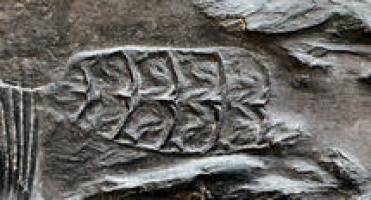
A 30-million-year-old fossil has revealed how remoras - also called sharksuckers - evolved the sucker that enables them to stick to other fish and 'hitch a ride'. Previous evidence, such as the segmented structure of the sucker and how it develops in a similar way to fins in normal fish, led scientists to believe that it must be a modified dorsal fin - the fin located on the back of normal fish.
History & Archeology - Astronomy & Space - 15.07.2013
The Beginning of Time?
British archaeology experts have discovered what they believe to be the world's oldest 'calendar', created by hunter-gatherer societies and dating back to around 8,000 BC. The Mesolithic monument was originally excavated in Aberdeenshire, Scotland, by the National Trust for Scotland in 2004. Now analysis by a team led by the University of Birmingham, published today (July 15, 2013) in the journal Internet Archaeology, sheds remarkable new light on the luni-solar device, which pre-dates the first formal time-measuring devices known to Man, found in the Near East, by nearly 5,000 years.
Life Sciences - History & Archeology - 03.07.2013
Study of mitochondrial DNA ties ancient remains to living descendants
Members of the Metlakatla community are collaborating with scientists in ongoing genetic studies of Native peoples in British Columbia. (Those pictured asked that their names be withheld. CHAMPAIGN, Ill. Researchers report that they have found a direct genetic link between the remains of Native Americans who lived thousands of years ago and their living descendants.
Life Sciences - History & Archeology - 26.06.2013
Genome of 700,000-year-old horse sequenced
The oldest genome so far from a prehistoric creature has been sequenced by an international team, led by scientists from the Natural History Museum of Denmark (University of Copenhagen). The team, which included Dr Jakob Vinther of the University of Bristol, sequenced and analysed short pieces of DNA molecules preserved in bone-remnants from a horse frozen for the last 700,000 years in the permafrost of Yukon, Canada.
History & Archeology - 01.06.2013
Letter from Robert the Bruce to Edward II reveals power struggle in the build-up to Bannockburn
New research has revealed a letter written in 1310 by Robert Bruce to King Edward II, presenting historians with fresh information about a pivotal time in the Wars of Scottish Independence. The letter was sent less than four years before Robert Bruce won a famous victory at the Battle of Bannockburn against the English king which paved the way for Scottish independence.
History & Archeology - 22.05.2013
New archaeological ‘high definition’ sourcing sharpens understanding of the past
A new method of sourcing the origins of artefacts in high definition is set to improve our understanding of the past. Dr Ellery Frahm at the University of Sheffield developed the new technology to better study Mesopotamian obsidian tools unearthed in Syria, where cultural heritage is threatened by the ongoing conflict.
Social Sciences - History & Archeology - 30.04.2013
Researchers crack MI9 codes to discover PoWs’ wartime requests
Mathematicians, historians and geographers have worked together to crack codes used by MI9 to conceal information going in and out of prisoner of war camps across Europe during the Second World War. They give a fascinating insight into how the Allies were trying to engineer escapes from the camps, but also show the PoWs were passing on vital military intelligence to their commanders back in London.
Linguistics & Literature - History & Archeology - 25.04.2013

Berkeley Lab's sound-restoration experts have done it again. They've helped to digitally recover a 128-year-old recording of Alexander Graham Bell's voice, enabling people to hear the famed inventor speak for the first time. The recording ends with Bell saying "in witness whereof, hear my voice, Alexander Graham Bell." The project involved a collaboration between Smithsonian's National Museum of American History, the Library of Congress, and Berkeley Lab.
Life Sciences - History & Archeology - 24.04.2013
Museum find proves exotic ’big cat’ prowled British countryside a century ago
The rediscovery of a mystery animal in a museum's underground storeroom by an undergraduate at the University of Bristol proves that a non-native 'big cat' prowled the British countryside at the turn of the last century. The animal's skeleton and mounted skin was rediscovered by Max Blake - now a PhD student at Aberystwyth University - while studying for his undergraduate degree in zoology at Bristol.
Life Sciences - History & Archeology - 24.04.2013
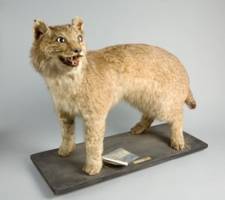
Museum find proves exotic 'big cat' prowled British countryside a century ago The rediscovery of a mystery animal in a museum's underground storeroom proves that a non-native 'big cat' prowled the British countryside at the turn of the last century. The animal's skeleton and mounted skin was analysed by a multi-disciplinary team of Durham University scientists and fellow researchers at Bristol, Southampton and Aberystwyth universities and found to be a Canadian lynx - a carnivorous predator more than twice the size of a domestic cat.


Health - Today
AI was supposed to ease doctors' workload - instead they spend hours correcting errors
AI was supposed to ease doctors' workload - instead they spend hours correcting errors
Pharmacology - Today
International trial finds rapid diagnostic testing alone does not reduce antibiotic prescribing for respiratory infections
International trial finds rapid diagnostic testing alone does not reduce antibiotic prescribing for respiratory infections
Social Sciences - Today
Social background shapes how hard children work, according to a study by UC3M
Social background shapes how hard children work, according to a study by UC3M
Innovation - Today
With Robotics Innovation Center, CMU and Hazelwood Partners Sustain Community Collaborations
With Robotics Innovation Center, CMU and Hazelwood Partners Sustain Community Collaborations