


Event - Mar 17
CEA Leti to Showcase Integrated Expertise In Microelectronics Reliability at IRPS 2026
CEA Leti to Showcase Integrated Expertise In Microelectronics Reliability at IRPS 2026

Health - Mar 17
AI was supposed to ease doctors' workload - instead they spend hours correcting errors
AI was supposed to ease doctors' workload - instead they spend hours correcting errors



Pharmacology - Mar 17
International trial finds rapid diagnostic testing alone does not reduce antibiotic prescribing for respiratory infections
International trial finds rapid diagnostic testing alone does not reduce antibiotic prescribing for respiratory infections

Social Sciences - Mar 17
Social background shapes how hard children work, according to a study by UC3M
Social background shapes how hard children work, according to a study by UC3M
Innovation - Mar 17
With Robotics Innovation Center, CMU and Hazelwood Partners Sustain Community Collaborations
With Robotics Innovation Center, CMU and Hazelwood Partners Sustain Community Collaborations




news
Paleontology
Results 181 - 200 of 323.
Paleontology - 18.05.2022

Mouse deer are among the smallest ruminants in the world. Today, they live in the tropics of Africa and Asia and are barely larger than hares. Males and females differ little in appearance. But that was not the case about eleven million years ago. Josephina Hartung and Professor Madelaine Böhme from the Senckenberg Centre for Human Evolution and Palaeoenvironment at the University of Tübingen came across a previously unknown difference between the sexes while examining two fossil mouse deer skulls from the Hammerschmiede clay pit in the Allgäu region of Germany.
Paleontology - Earth Sciences - 17.05.2022

Twenty million years ago, the Swiss Plateau region, or -Mittelland-, was an ocean in which dolphins swam.
Life Sciences - Paleontology - 10.05.2022

Childbirth in humans is much more complex and painful than in great apes. It was long believed that this was a result of humans- larger brains and the narrow dimensions of the mother's pelvis. Researchers at the University of Zurich have now used 3D simulations to show that childbirth was also a highly complex process in earlier hominin species that gave birth to relatively small-brained newborns - with important implications for their cognitive development.
Paleontology - Earth Sciences - 10.05.2022

A new University of Michigan study that used fossil oyster shells as paleothermometers found the shallow sea that covered much of western North America 95 million years ago was as warm as today's tropics. The study provides the first direct temperature data from that vast mid-latitude sea during the height of the Cretaceous Thermal Maximum, one of the planet's hottest climate intervals of the past several hundred million years.
Paleontology - 14.04.2022

A fragment of the asteroid that hit the Earth 66 million years ago and led to the extinction of the dinosaurs, and the first ever fossilised remains of a dinosaur killed by the asteroid impact, are thought to be amongst the latest finds unearthed by University of Manchester palaeontologist Robert DePalma at a dig site he named Tanis in North Dakota.
Earth Sciences - Paleontology - 30.03.2022

Researchers use new techniques to determine when limestone layers and fossils were formed during dinosaur age, 66 to 73 million years ago Wednesday, March 30, 2022 — Geologists from the Vrije Universiteit Brussel and KU Leuven, in collaboration with Maastricht Natural History Museum and Dutch conservation organisation Natuurmonumenten, have mapped the million-year-old rocks in the quarries near Maastricht.
Life Sciences - Paleontology - 24.03.2022

A new study published in Nature reveals that Spinosaurus, among the largest carnivorous dinosaurs ever discovered, could hunt underwater. New research by a multi-institution team including the Field Museum of Natural History, Chicago, the University of Oxford and the University of Cambridge used X-ray imaging of fossilised bones to analyse bone density.
Life Sciences - Paleontology - 22.03.2022
Study Reconsiders Early Evolution of Sea Urchins
Genome-scale analysis of evolutionary relationships and times of origin of sea urchins and their relatives prompts re-evaluation of their fossil record A study led by researchers at Scripps Institution of Oceanography at UC San Diego provides new insight on the origins and early evolution of echinoids, a group of marine animals that includes modern sea urchins, sand dollars, and their relatives.
Paleontology - Life Sciences - 02.03.2022

Palaeobiologists from the University of Tübingen have described a previously unknown turtle species that lived in what is now Romania some 70 million years ago. The reptile, measuring 19 cm in length, has no close relatives now but is a member of the larger group of side-necked turtles that are today found mostly in the southern hemisphere.
Life Sciences - Paleontology - 23.02.2022

An international team of researchers led by VU Amsterdam has discovered that the aftermath of the Chicxulub meteorite impact which killed nearly all of the dinosaurs, struck Earth during springtime. They arrived at this conclusion after examining thin sections of the bones from fossil fish, using high-resolution synchrotron X-ray scans and carbon isotope records.
Paleontology - Life Sciences - 22.02.2022

An international research team led by biologists from Friedrich Schiller University Jena has discovered material evidence that ants already lived in a special social system based on the division of labour more than 100 million years ago. Ants live in states organised according to the division of tasks.
Paleontology - Life Sciences - 21.02.2022
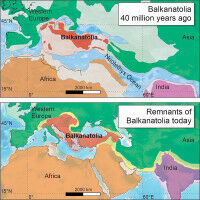
A team of geologists and palaeontologists has discovered that, some 50 million years ago, there was a low-lying continent separating Europe from Asia that they have named Balkanatolia. Geographical changes 40 to 34 million years ago connected this continent to its two neighbours, paving the way for the replacement of European mammals by Asian mammals.
Paleontology - Life Sciences - 10.01.2022
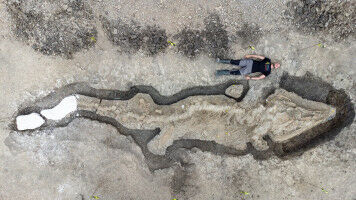
The fossilised remains of Britain's largest ichthyosaur, colloquially known as a 'Sea Dragon', have been discovered at the Rutland Water Nature Reserve, owned and run by Anglian Water. It is the biggest and most complete skeleton of its kind found to date in the UK and is also thought to be the first ichthyosaur of its species found in the country.
Life Sciences - Paleontology - 10.01.2022
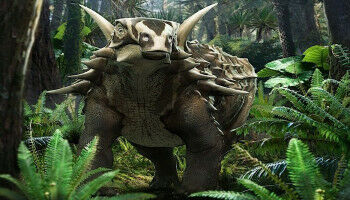
German and Austrian scientists took a closer look at the braincase of a dinosaur from Austria. The group examined the fossil with a micro-CT and found surprising new details: it was sluggish and deaf. The respective study got recently published in the scientific journal scientific reports. Ankylosaurs could grow up to eight meters in body length and represent a group of herbivorous dinosaurs, also called 'living fortresses': Their body was cluttered with bony plates and spikes.
Life Sciences - Paleontology - 06.01.2022
Correcting the fossil record: Researchers say four-legged ’snake’ is different ancient animal
It all started with a grand claim: scientists had discovered the first known four-legged snake fossil from Brazil. The specimen, named Tetrapodophis amplectus , was small - about the size of a pencil - with tiny limbs. It was considered a significant discovery that offered paleontologists a major clue into the transition from limbed lizards to limbless snakes.
Life Sciences - Paleontology - 22.12.2021

The most detailed timeline of mammal evolution to date has been set out in a new study co-led by UCL researchers. The Nature paper describes a new and fast computational approach to obtain precisely dated evolutionary trees, known as 'timetrees'. The authors used the novel method to analyse a mammal genomic dataset and answer a long-standing question around whether modern placental mammal groups originated before or after the Cretaceous-Palaeogene (K-Pg) mass extinction, which wiped out over 70% of all species, including all dinosaurs.
Paleontology - Life Sciences - 21.12.2021

A 72- to 66-million-year-old embryo found inside a fossilised dinosaur egg sheds new light on the link between the behaviour of modern birds and dinosaurs, according to a new study. The embryo, dubbed 'Baby Yingliang', was discovered in the Late Cretaceous rocks of Ganzhou, southern China and belongs to a toothless theropod dinosaur, or oviraptorosaur.
Paleontology - Life Sciences - 17.12.2021

Giant, long-necked sauropods, thought to include the largest land animals ever, preferred to live in warmer regions on Earth, suggesting they may have had a different physiology from other dinosaurs, finds a new study led by researchers at UCL and the University of Vigo. The study, published in the journal Current Biology , investigated the enigma of why sauropod fossils are only found at lower latitudes, while fossils of other main dinosaur types seem ubiquitously present, with many located in the polar regions.
Paleontology - Life Sciences - 16.12.2021

Theropod dinosaurs evolved more robust jaws through time allowing them to consume tougher food, a new study reveals. Researchers used digital modelling and computer simulation to uncover a common trend of jaw strengthening in theropods - expanding the rear jaw portion in all groups, as well as evolving an upturned jaw in carnivores and a downturned jaw in herbivores.
Paleontology - Life Sciences - 08.12.2021
Dinosaurs Spring to Extinction: Springtime pinpointed as the season for dinosaur extinction
An international team led by researchers from The University of Manchester today published in Scientific Reports a groundbreaking study that sheds new light on the timing associated with the dinosaur-killing asteroid impact that occurred 66 million years ago. The study, " Seasonal calibration of the end-Cretaceous Chicxulub Impact Event ", provides new evidence that helps us to understand the significance of the timing for the events that brought an end to the dinosaurs—and 75% of life on Earth.


Event - Mar 17
CEA Leti to Showcase Integrated Expertise In Microelectronics Reliability at IRPS 2026
CEA Leti to Showcase Integrated Expertise In Microelectronics Reliability at IRPS 2026
Health - Mar 17
AI was supposed to ease doctors' workload - instead they spend hours correcting errors
AI was supposed to ease doctors' workload - instead they spend hours correcting errors
Pharmacology - Mar 17
International trial finds rapid diagnostic testing alone does not reduce antibiotic prescribing for respiratory infections
International trial finds rapid diagnostic testing alone does not reduce antibiotic prescribing for respiratory infections
Social Sciences - Mar 17
Social background shapes how hard children work, according to a study by UC3M
Social background shapes how hard children work, according to a study by UC3M
Innovation - Mar 17
With Robotics Innovation Center, CMU and Hazelwood Partners Sustain Community Collaborations
With Robotics Innovation Center, CMU and Hazelwood Partners Sustain Community Collaborations