




Health - Today
AI was supposed to ease doctors' workload - instead they spend hours correcting errors
AI was supposed to ease doctors' workload - instead they spend hours correcting errors




Pharmacology - Today
International trial finds rapid diagnostic testing alone does not reduce antibiotic prescribing for respiratory infections
International trial finds rapid diagnostic testing alone does not reduce antibiotic prescribing for respiratory infections

Social Sciences - Today
Social background shapes how hard children work, according to a study by UC3M
Social background shapes how hard children work, according to a study by UC3M
Innovation - Today
With Robotics Innovation Center, CMU and Hazelwood Partners Sustain Community Collaborations
With Robotics Innovation Center, CMU and Hazelwood Partners Sustain Community Collaborations





news
Paleontology
Results 241 - 260 of 323.
Life Sciences - Paleontology - 28.10.2020
Giant lizards learnt to fly over millions of years
Pterodactyls and related winged reptiles that lived alongside the dinosaurs steadily improved their ability to fly, becoming the deadly masters of the sky, over the course of millions of years. A new study, '150 million years of sustained increase in pterosaur flight efficiency' , published in the journal Nature has shown that pterosaurs - a group of creatures that became Earth's first flying vertebrates - evolved to improve their flight performance over their 150 million-year existence, before going extinct at the same time as dinosaurs 66 million years ago.
Life Sciences - Paleontology - 28.10.2020
Pterosaurs undergo dental examination to reveal clues about diets and lifestyles
Microscopic analysis of the teeth of pterosaurs has revealed new insights into the diets and behaviours of Earth's earliest flying reptiles. Researchers at the University of Leicester's Centre for Palaeobiology Research and the University of Birmingham used dental microwear analysis to look at the wear patterns still visible on the teeth of 17 different species of pterosaur.
Life Sciences - Paleontology - 12.10.2020
Ancient tiny teeth reveal first mammals lived more like reptiles
Reconstruction of Morganucodon (left) and Kuehneotherium (right) hunting in Early Jurassic Wales 200 million years ago. Original painting by John Sibbick, 2013. Copyright: Pam Gill Synchrotron micro-CT scan of a fossil Morganucodon tooth root from 200 million years ago. Elis Newham Scientists count fossilised growth rings in teeth like tree rings to find out how long the earliest mammals lived.
Paleontology - Life Sciences - 21.09.2020
Modelling of ancient fossil movement reveals step in the evolution of posture in dinosaur and crocodile ancestors
Life reconstruction of Euparkeria highlighting the body parts investigated in this study. Illustration: Oliver Demuth. The oblique ankle joint did not allow Euparkeria to assume a fully upright posture as the foot also turns medially when the ankle joint is extended. An ankle joint allowing a more upright posture evolved later independent from the hip structure.
Environment - Paleontology - 16.09.2020
Discovery of a new mass extinction
Summary of major extinction events through time, highlighting the new, Carnian Pluvial Episode at 233 million years ago. D. Bonadonna/ MUSE, Trento. September 2020 It's not often a new mass extinction is identified; after all, such events were so devastating they really stand out in the fossil record.
Life Sciences - Paleontology - 27.08.2020

Prepared by Megan Whitney with Harvard University and Christian Sidor with the University of Washington and the Burke Museum of Natural History and Culture. University of Washington press release here. Reference: " Evidence of torpor in the tusks of Lystrosaurus from the Early Triassic of Antarctica " by Whitney MR and Sidor CA. Communications Biology.
Paleontology - 11.08.2020
Some dinosaurs could fly before they were birds
Updated evolutionary tree and biomechanical estimates of feathered dinosaurs and early birds show powered flight may have evolved in these animals at least three different times New research using the most comprehensive study of feathered dinosaurs and early birds has revised the evolutionary relationships of dinosaurs at the origin of birds.
Life Sciences - Paleontology - 06.08.2020

Its neck was three times as long as its torso, but had only thirteen extremely elongated vertebrae: "Tanystropheus", a bizarre giraffe-necked reptile which lived 242 million years ago, is a paleontological absurdity. A new study led by the University of Zurich has now shown that the creature lived in water and was surprisingly adaptable.
Paleontology - Life Sciences - 04.08.2020

Threatened with extinction despite perfect adaptation Angel sharks are sharks, but with their peculiarly flat body they rather resemble rays. An international research team led by Faviel A. López-Romero and Jürgen Kriwet of the Institute of Palaeontology has now investigated the origin of this body shape.
Earth Sciences - Paleontology - 29.07.2020

Geological evidence suggests the known dinosaur groups diverged early on, supporting the traditional dinosaur family tree. The classic dinosaur family tree has two subdivisions of early dinosaurs at its base: the Ornithischians, or bird-hipped dinosaurs, which include the later Triceratops and Stegosaurus ; and the Saurischians, or lizard-hipped dinosaurs, such as Brontosaurus and Tyrannosaurus .
Paleontology - Chemistry - 10.07.2020

Step aside, skeletons - a new world of biochemical "signatures" found in all kinds of ancient fossils is revealing itself to paleontologists, providing a new avenue for insights into major evolutionary questions. In a new study published Advances , Yale researchers outline a novel approach to finding biological signals long thought to be lost in the process of fossilization.
Paleontology - Earth Sciences - 17.06.2020

The first dinosaur eggs had a soft shell, say paleontologists from Yale and the American Museum of Natural History (AMNH). The finding upends decades of conventional wisdom by the scientific community. For many years there was scant fossil evidence of dinosaur eggs, and all known examples were characterized by thick, calcified shells - leading paleontologists to speculate that all dinosaur eggs were hard-shelled, like those of modern crocodiles and birds.
Life Sciences - Paleontology - 17.06.2020
Insect crunching reptiles on ancient islands of the UK
By analysing the fossilised jaw mechanics of reptiles who lived in the Severn Channel region of the UK 200-million-years ago, researchers from the University of Bristol have shown that they weren't picky about the types of insects they ate - enjoying both crunchy and less crunchy varieties. The study, published today in the journal Palaeontology , describes how the team analysed the biomechanics of the skulls of some early lizard-like reptiles called rhynchocephalians to explore their diets.
Paleontology - Life Sciences - 12.06.2020
Clay is king for creating ancient fossils. In a new study, researchers confirmed that kaolinite, a mineral found in certain fine-grained rocks around the world, is a key ingredient for preserving some of the earliest forms of complex life. The researchers also said the importance of kaolinite in the fossilization process has led to a bias in the early fossil record toward organisms that lived in places where kaolinite forms.
Paleontology - Life Sciences - 11.06.2020
Oldest relative of ragworms and earthworms discovered
Scientists at the Universities of Oxford, Exeter, Yunnan and Bristol and have discovered the oldest fossil of the group of animals that contains earthworms, leeches, ragworms and lugworms. This discovery pushes the origin of living groups of these worms (polychaetes) back tens of millions of years, demonstrating that they played an important part in the earliest animal ecosystems.
Paleontology - Environment - 22.05.2020
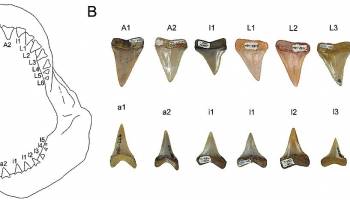
Paleo-kindergarten ensured evolutionary success millions of years ago An international research team led by Jaime A. Villafaña from the Institute of Palaeontology at the University of Vienna discovered the first fossil nursery area of the great white shark, Carcharodon carcharias in Chile. This discovery provides a better understanding of the evolutionary success of the largest top predator in today's oceans in the past and could contribute to the protection of these endangered animals.
Life Sciences - Paleontology - 20.05.2020
Ancient giant armoured fish fed in a similar way to basking sharks
Scientists from the University of Bristol and the University of Zurich have shown that the Titanichthys - a giant armoured fish that lived in the seas and oceans of the late Devonian period 380-million-years ago - fed in a similar manner to modern day basking sharks. Titanichthys has long been known as one of the largest animals of the Devonian - its exact size is difficult to determine, but it likely exceeded five metres in length; like in the basking shark, its lower jaw reached lengths exceeding one metre.
Life Sciences - Paleontology - 20.05.2020
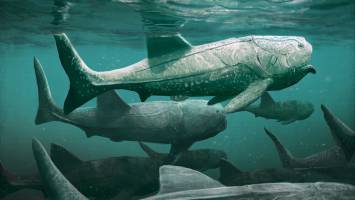
Scientists from the University of Zurich and the University of Bristol have investigated the jaw mechanics of Titanichthys, a giant armored fish that roamed the seas and oceans of the late Devonian period 380 million years ago. New findings suggest that it fed by swimming through water slowly with its mouth open wide to capture high concentrations of plankton - similar to modern-day basking sharks.
Life Sciences - Paleontology - 19.05.2020
Ancient reptile had mammal-like tooth enamel
Priosphenodon specimens found in Argentina show the Late Cretaceous reptile evolved to have resilient tooth enamel similar to that in mammals A new study by McGill University and the University of Alberta (UofA) paleontologists shows that one type of ancient reptiles evolved a special type of tooth enamel, similar to that of mammals, with high resistance to wear and tear.
Paleontology - Earth Sciences - 23.04.2020
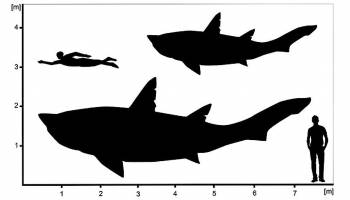
Fossil vertebrae give insights into growth and extinction of an enigmatic shark group Scientists of the University of Vienna examined parts of a vertebral column, which was found in northern Spain in 1996, and assigned it to the extinct shark group Ptychodontidae. In contrast to teeth, shark vertebrae bear biological information, like body size, growth, and age and allowed the team surrounding Patrick L. Jambura to gain new insights into the biology of this mysterious shark group.


Health - Today
AI was supposed to ease doctors' workload - instead they spend hours correcting errors
AI was supposed to ease doctors' workload - instead they spend hours correcting errors
Pharmacology - Today
International trial finds rapid diagnostic testing alone does not reduce antibiotic prescribing for respiratory infections
International trial finds rapid diagnostic testing alone does not reduce antibiotic prescribing for respiratory infections
Social Sciences - Today
Social background shapes how hard children work, according to a study by UC3M
Social background shapes how hard children work, according to a study by UC3M
Innovation - Today
With Robotics Innovation Center, CMU and Hazelwood Partners Sustain Community Collaborations
With Robotics Innovation Center, CMU and Hazelwood Partners Sustain Community Collaborations