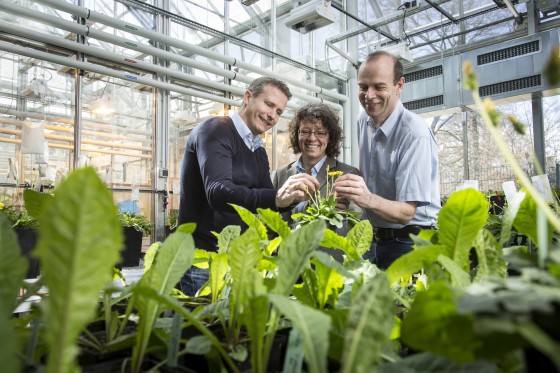
 Left to right: Christian Schulze Gronover, Carla Recker and Dirk Prüfer make use of the Russian dandelion to obtain natural rubber.
In a joint project between scientists of the Fraunhofer Institute for Molecular Biology and Applied Ecology IME, the Department of Biology and Biotechnology (IBBP) at the University of Münster and the tire manufacturer Continental, all prerequisites for a sustainable use of Russian dandelion as an alternative rubber resource were established, and first car tire prototypes have been produced. For their work and its application as a source of natural rubber, Prof. Dirk Prüfer and Dr. Christian Schulze Gronover of IME and IBBP as well as Dr. Carla Recker of Continental receive the 2015 Joseph von Fraunhofer Prize today at the annual meeting of the Fraunhofer Gesellschaft in Wiesbaden, in the presence of German Federal President Joachim Gauck and the Premier of Hesse, Volker Bouffier. The milky sap of the dandelion shows similarities to that of the rubber tree, and most importantly contains caoutchouc - the raw material for rubber production. 'The plant is extremely resilient, able to grow in moderate climates and even in soil that is not or just barely suited for the cultivation of food and feed crops', explain scientists Christian Schulze Gronover and Dirk Prüfer. However, common dandelion - a plant species native to Germany - does not provide enough rubber for being utilized on industrial scale. In order to increase the yield, the researchers have focused on the Russian dandelion that already produces significant amounts of rubber in its roots. With their team, Dirk Prüfer and Christian Schulze Gronover have identified genes that promote the production of rubber - or impede it, respectively.
TO READ THIS ARTICLE, CREATE YOUR ACCOUNT
And extend your reading, free of charge and with no commitment.
Your Benefits
- Access to all content
- Receive newsmails for news and jobs
- Post ads