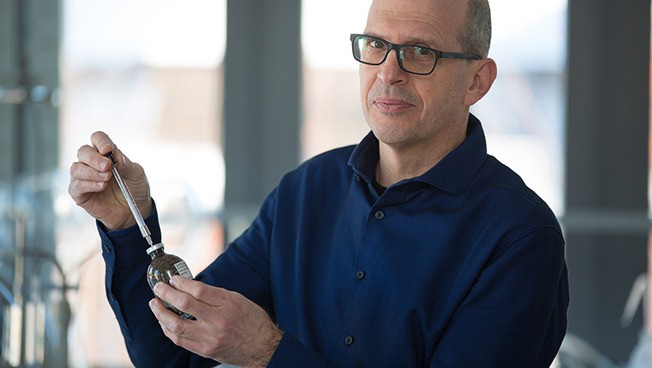
Photo: UHH/Dingler Christian Knoblauch mit einer vierzigtausend Jahre alten Bodenprobe aus der sibirischen Arktis
In a seven-year laboratory study, Dr. Christian Knoblauch from Universität Hamburg's Center for Earth System Research and Sustainability (CEN) and an international team have shown, for the first time, that significantly more methane is produced by thawing permafrost than previously thought. The findings, published today Climate Change, make it possible to better predict how much greenhouse gas could be released by the thawing of the Arctic permafrost. Methane (CH4) is a potent greenhouse gas, which is roughly 30 times more harmful to the climate than carbon dioxide (CO2). Both gases are produced in thawing permafrost as dead animal and plant remains are decomposed. However, methane is only formed if no oxygen is available. Until now, it was assumed that larger amounts of greenhouse gases are formed when the ground was dry and well aerated - when oxygen was available. Christian Knoblauch and his colleagues have now demonstrated that water-saturated permafrost soils without oxygen can be twice as harmful to the climate as dry soils - which means the role of methane has been greatly underestimated.
TO READ THIS ARTICLE, CREATE YOUR ACCOUNT
And extend your reading, free of charge and with no commitment.