




Health - Today
AI was supposed to ease doctors' workload - instead they spend hours correcting errors
AI was supposed to ease doctors' workload - instead they spend hours correcting errors



Pharmacology - Today
International trial finds rapid diagnostic testing alone does not reduce antibiotic prescribing for respiratory infections
International trial finds rapid diagnostic testing alone does not reduce antibiotic prescribing for respiratory infections

Social Sciences - Today
Social background shapes how hard children work, according to a study by UC3M
Social background shapes how hard children work, according to a study by UC3M
Innovation - Today
With Robotics Innovation Center, CMU and Hazelwood Partners Sustain Community Collaborations
With Robotics Innovation Center, CMU and Hazelwood Partners Sustain Community Collaborations





news
Paleontology
Results 201 - 220 of 323.
Paleontology - Life Sciences - 08.12.2021

A research team led by scientists from Cardiff University has provided the first ever 3D visualisation of an ammonite - a marine mollusc group that became extinct with the dinosaurs around 66 million years ago. The new images have allowed the team to analyse the muscles and organs of an ammonite for the very first time, throwing new light on how the cephalopod mollusc was able to swim through the oceans and defend itself from predators.
Life Sciences - Paleontology - 30.11.2021

A Triassic herbivore, known for its supposed similarities to a modern-day ostrich, has been revealed to have an entirely different approach to feeding from previously thought, according to research involving UCL and University of Birmingham researchers. The new findings, published in The Anatomical Record , reveal a much broader diversity of herbivore behaviour during the Triassic period than has been recognised to date.
Life Sciences - Paleontology - 27.10.2021

Many animals have tusks, from elephants to walruses to hyraxes. But one thing today's tusked animals have in common is that they're all mammals - no known fish, reptiles or birds have them. But that was not always the case. In a study published Oct. 27 in the Proceedings of the Royal Society B, a team of paleontologists at Harvard University, the Field Museum, the University of Washington and Idaho State University traced the first tusks back to ancient mammal relatives that lived before the dinosaurs.
Paleontology - 22.10.2021

Fossil footprints found in an Ipswich coal mine have long been thought to be that of a large 'raptor-like' predatory dinosaur, but scientists have found they were instead left by a timid long-necked herbivore. University of Queensland palaeontologist Dr Anthony Romilio recently led an international team to re-analyse the footprints, dated to the latter part of the Triassic Period, around 220 million-year-ago.
Paleontology - Life Sciences - 20.10.2021

Researchers have discovered the oldest known modern crab - trapped in amber since the time of the dinosaurs. The 100-million-year-old fossil of the crab, Cretapsara athanata , comes from Myanmar, in Southeast Asia. It fills a major gap in the fossil record for crabs and resets the timetable for when marine crabs made their way inland.
Paleontology - Earth Sciences - 11.10.2021

The oldest known footprints of pre-humans were found on the Mediterranean island of Crete and are at least six million years old, says an international team of researchers from Germany, Sweden, Greece, Egypt and England, led by Tübingen scientists Uwe Kirscher and Madelaine Böhme of the Senckenberg Center for Human Evolution and Palaeoenvironment at the University of Tübingen.
Paleontology - Life Sciences - 06.10.2021

Scientists from the Natural History Museum and the University of Birmingham have described a new species of dinosaur from specimens found in a quarry in Pant-y-ffynnon in southern Wales. Following on from a new species of ankylosaur , Pendraig milnerae marks the second new species of dinosaur described by Museum scientists in the last few weeks.
Paleontology - Life Sciences - 23.09.2021

An unusual fossil showing a series of spikes fused to a rib has been revealed to be the remains of the oldest ankylosaur ever found and the first from the African continent. The exciting discovery was made in the Middle Atlas Mountains of Morocco at the same site where researchers from the Natural History Museum (NHM) previously discovered the oldest stegosaur ever found.
Paleontology - Environment - 14.09.2021

Research from the Milner Centre for Evolution suggests modern snakes evolved from a handful of ancestors that survived the asteroid that killed the dinosaurs. Last updated on Tuesday 14 September 2021 A new study suggests that all living snakes evolved from a handful of species that survived the giant asteroid impact that wiped out the dinosaurs and most other living things at the end of the Cretaceous.
Life Sciences - Paleontology - 13.09.2021

Researchers at the University of Toronto have discovered what are believed to be the oldest known cavities found in a mammal - the likely result of a diet that included eating fruit. The cavities were discovered in fossils of Microsyops latidens, a pointy-snouted animal - no bigger than a racoon - that was part of a group of mammals known as stem primates.
Paleontology - Environment - 31.08.2021

A new study of two approximately 52-million-year-old fossil finds from the Green River Formation in Wyoming, USA, has fitted them into the evolutionary history of crocodiles. Biogeologists Jules Wal-ter, Dr. Márton Rabi of the University of Tübingen, working with some other colleagues, determined the extinct species Tsoabichi greenriverensis to be an early caiman crocodile.
Paleontology - Life Sciences - 25.08.2021

Tyrannosaurus rex , the fearsome predator that once roamed what is now western North America, appears to have had an East Coast cousin. A new study by Yale undergraduate Chase Doran Brownstein describes two dinosaurs that inhabited Appalachia - a once isolated land mass that today composes much of the eastern United States - about 85 million years ago: an herbivorous duck-billed hadrosaur and a carnivorous tyrannosaur.
Life Sciences - Paleontology - 02.08.2021

Göttingen research team creates phylogenetic tree of leaf insects An international research team led by the University of Göttingen has studied the evolution of the walking leaves. Walking leaves belong to the stick insects and ghost insects that, unlike their approximately 3,000 branch-like relatives, do not imitate twigs.
Paleontology - Environment - 29.06.2021

Ten million years before the well-known asteroid impact that marked the end of the Mesozoic Era, dinosaurs were already in decline. That is the conclusion of the Franco-Anglo-Canadian team led by CNRS researcher Fabien Condamine from the Institute of Evolutionary Science of Montpellier (CNRS / IRD / University of Montpellier), which studied evolutionary trends during the Cretaceous for six major families of dinosaurs, including those of the tyrannosaurs, triceratops, and hadrosaurs.
Life Sciences - Paleontology - 16.06.2021

An international research team involving UCL scientists has described a new species of Oculudentavis, providing further evidence that the animal first identified as a hummingbird-sized dinosaur was actually a lizard. The new species, named Oculudentavis naga in honor of the Naga people of Myanmar and India, and was studied using a partial skeleton that includes a complete skull, exquisitely preserved in amber with visible scales and soft tissue.
Environment - Paleontology - 10.06.2021
Dinosaurs lived in greenhouse climate with hot summers
New climate reconstruction method provides precise picture of climate 78 million years ago Palaeoclimatologists study climate of the geological past. Using an innovative technique, new research by an international research team led by Niels de Winter (VUB-AMGC & Utrecht University) shows for the first time that dinosaurs had to deal with greater seasonal differences than previously thought.
Paleontology - Environment - 14.05.2021

The evolution of herbivores is linked to the plants that survived and adapted after the 'great dying', when over 90% of the world's species were wiped out 252 million years ago. Researchers at the University of Bristol found that plant eaters diversified quickly after mass extinctions to eat different kinds of plants, and the ones that were able to chew harsher materials, which reflected the drying conditions of the late Triassic, became the most successful.
Paleontology - 20.04.2021
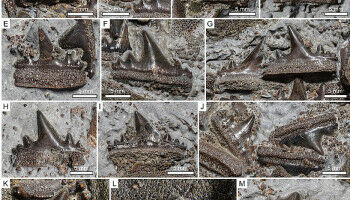
In a new study, an international team led by Sebastian Stumpf from the University of Vienna describes a fossil skeleton of an ancient shark, which is assigned to a new, previously unknown genus and species. This rare fossil find comes from the Kimmeridge Clay Formation in England, a series of sedimentary rocks that was formed in a shallow, tropical-subtropical sea during the Upper Jurassic, about 150 million years ago.
Paleontology - 16.04.2021
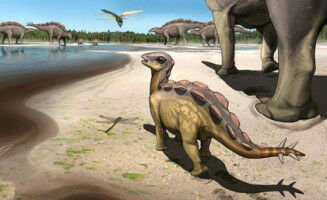
A single footprint left by a cat-sized dinosaur around 100 million years ago has been discovered in China by an international team of palaeontologists. University of Queensland researcher Dr Anthony Romilio was part of the team that investigated the track, originally found by Associate Professor Lida Xing from the China University of Geosciences (Beijing).
Life Sciences - Paleontology - 12.04.2021
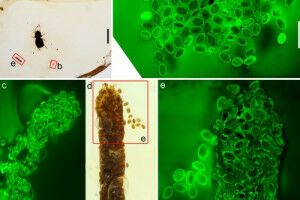
An amber fossil of a Cretaceous beetle has shed some light on the diet of one of the earliest pollinators of flowering plants. The animal's remains were unearthed by researchers at the University of Bristol and the Nanjing Institute of Geology and Palaeontology of the Chinese Academy of Sciences (NIGPAS) who were able to study its fossil faecal matter, which was composed solely of pollen.


Health - Today
AI was supposed to ease doctors' workload - instead they spend hours correcting errors
AI was supposed to ease doctors' workload - instead they spend hours correcting errors
Pharmacology - Today
International trial finds rapid diagnostic testing alone does not reduce antibiotic prescribing for respiratory infections
International trial finds rapid diagnostic testing alone does not reduce antibiotic prescribing for respiratory infections
Social Sciences - Today
Social background shapes how hard children work, according to a study by UC3M
Social background shapes how hard children work, according to a study by UC3M
Innovation - Today
With Robotics Innovation Center, CMU and Hazelwood Partners Sustain Community Collaborations
With Robotics Innovation Center, CMU and Hazelwood Partners Sustain Community Collaborations