

Pharmacology - Mar 19
GSK, University of Oxford and Imperial College London launch centre to create computer models of lungs, liver, kidneys and cartilage
GSK, University of Oxford and Imperial College London launch centre to create computer models of lungs, liver, kidneys and cartilage
Innovation - Mar 19
India's new wave of Hindu Religious Entrepreneurship is reshaping our interpretation of success
India's new wave of Hindu Religious Entrepreneurship is reshaping our interpretation of success

Veterinary - Mar 19
New RVC study challenges common beliefs on desirable behaviours in designer 'Doodle' crossbreeds
New RVC study challenges common beliefs on desirable behaviours in designer 'Doodle' crossbreeds
Agronomy & Food Science - Mar 19
Bird Flu Risk to Danish Cattle - New Tool Can Warn Farmers Before Infection Spreads
Bird Flu Risk to Danish Cattle - New Tool Can Warn Farmers Before Infection Spreads
Chemistry - Mar 19
Leipzig University and Center for the Transformation of Chemistry conclude collaboration agreement
Leipzig University and Center for the Transformation of Chemistry conclude collaboration agreement
Psychology - Mar 19
Analysis: Trying your best in a second language? Here's why native speakers seem so rude
Analysis: Trying your best in a second language? Here's why native speakers seem so rude
Computer Science - Mar 18
SDU is part of global initiative to bring mathematical certainty to modern computing and artificial intelligence
SDU is part of global initiative to bring mathematical certainty to modern computing and artificial intelligence
news
Swiss Federal Institute of Technology Lausanne, EPFL
Results 1101 - 1120 of 1375.
Health - Microtechnics - 11.05.2017
A powered exoskeleton prevents the elderly from falling
The first smart exoskeleton that recognizes the loss of balance - and prevents falling - has been developed by researchers at Scuola Sant'Anna in Italy, EPFL in Switzerland, and tested at the Rehabilitation Center 'Fondazione Don Carlo Gnocchi' in Florence.
Health - Innovation - 09.05.2017
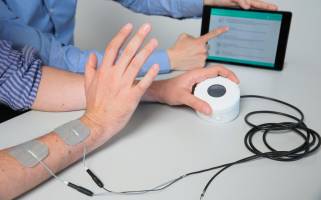
EPFL spin-off Intento has developed a patient-controlled electrical-stimulation device that helps stroke victims regain mobility in paralyzed arms. The promising results of the first clinical study are published in Archives of Physical Medicine and Rehabilitation. Every year, 17 million people worldwide suffer strokes, and a third are left paralyzed on one side of their body.
Innovation - Physics - 05.05.2017
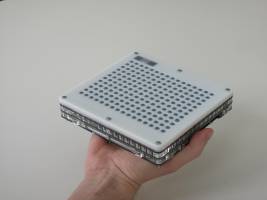
Researchers at EPFL have developed a tablet to help people with a visual impairment find their way around unfamiliar places.
Life Sciences - Health - 01.05.2017
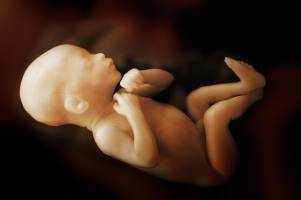
EPFL scientists have discovered the protein that kick-starts gene expression in developing embryos. The formation of a human embryo starts with the fertilization of the oocyte by the sperm cell. This yields the zygote, the primordial cell that carries one copy each of the maternal and paternal genomes.
Chemistry - Physics - 28.04.2017

EPFL scientists have combined 3D-printing with electroplating to easily produce high-quality metal electrodes that can be used as a molecular beam-splitter. Many measurement techniques, such as spectroscopy, benefit from the ability to split a single beam of light into two in order to measure changes in one of them.
Environment - Materials Science - 27.04.2017
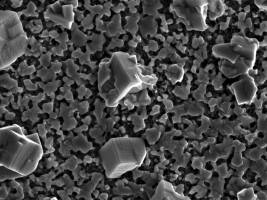
Publishing in Nature, EPFL scientists show how light affects perovskite film formation in solar cells, which is a critical factor in using them for cost-effective and energy-efficient photovoltaics. Perovskites are materials of immense interest in solar energy technology lately, as they promise to bring down the cost of solar cells to very low levels.
Innovation - 26.04.2017
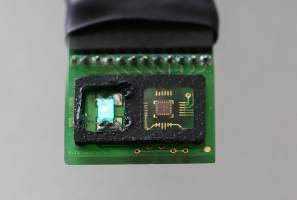
Nearly 80% of the battery power in smartwatches is used up by the heart-rate monitor. But a new generation of sensors developed by EPFL startup ActLight consumes five times less energy.
Materials Science - Environment - 25.04.2017

A team of EPFL and CSEM researchers in Neuchâtel has featured in Nature Energy with an astonishing new method for the creation of crystalline solar cells. These cells have electrical contacts at the back, which removes all shadowing at the front. Thanks to this new inexpensive approach, the fabrication process is greatly simplified, with efficiencies in the laboratory already surpassing 23%.
Health - 20.04.2017
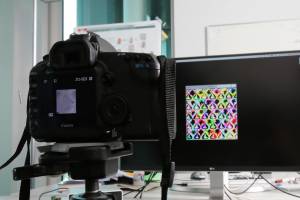
EPFL researchers took advantage of the limits of human vision to hide an image in a video. The image is invisible to the human eye, but not to a camera. Human visual perception works well and is very effective at seeing what's important to us. But our eyes are not capable of analyzing video images that last longer than 40 milliseconds.
Physics - Materials Science - 13.04.2017

EPFL scientists have uncovered the hidden properties of titanium dioxide, one of the most promising materials for light-conversion technology. Figure Caption : Lattice structure of anatase TiO 2 with a graphical representation of the 2D exciton that is generated by the absorption of light (purple wavy arrow).
Health - Pharmacology - 12.04.2017
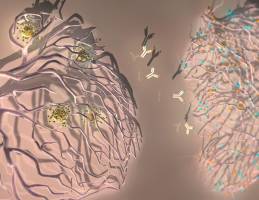
EPFL scientists have improved the efficacy of cancer immunotherapy by blocking two proteins that regulate the growth of tumor blood vessels. Cancer immunotherapy aims to enhance or restore the ability of the patient's immune system - namely T'cells - to recognize and attack cancer. But tumors use several strategies to fight back immune attacks, making immunotherapy efficacious only in a minority of the patients.
Health - Physics - 10.04.2017
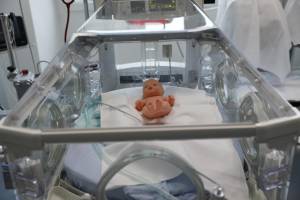
Researchers at EPFL and CSEM have developed a contactless and wireless camera system to continuously monitor the vital signs of premature babies. This system could replace skin sensors, which cause false alarms nearly 90% of the time. Preliminary tests will soon be carried out on newborns at University Hospital Zurich, a partner in the project.
Economics - Computer Science - 07.04.2017

Environment - Computer Science - 06.04.2017

Using a special multi-angle camera, EPFL researchers have gained important insights into the structure of snowflakes. Their aim is to improve the accuracy of snowfall measurements and winter weather forecasts. Imagine taking pictures of thousands of snowflakes from three different angles with a specialized instrument installed at an altitude of 2,500 meters.
Health - 05.04.2017
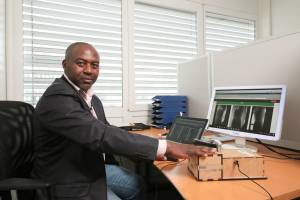
EPFL's Security and Cryptography Laboratory joined forces with startup Global ID to develop an encryption technique for processing biometric data captured via 3D finger vein recognition - a system that's next to impossible to counterfeit.
Pharmacology - Life Sciences - 30.03.2017
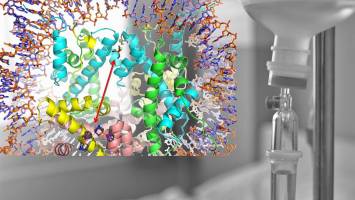
Scientists at EPFL and NTU have discovered that combining an anticancer drug with an antirheumatic produces improved effects against tumors. The discovery opens a new path for drug-drug synergy. One of the goals in pharmacology is to increase the efficiency of drugs by minimizing their side effects.
Life Sciences - Health - 28.03.2017
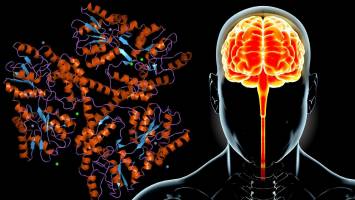
Huntington's disease is caused by a gene mutation that causes a protein to build up in the brain. In a world first, EPFL scientists have synthesized and studied modified forms of a mutant part of the protein, deepening our understanding of how it contributes to the disease, and pointing to new therapeutic strategies for treating it.
Life Sciences - Health - 23.03.2017
EPFL scientists have fully modeled the metabolism of the deadliest malaria parasite. The model offers unprecedented tools for developing a new generation of antimalarial therapies to overcome drug resistance. Image: Computational analysis of the malaria parasites' metabolism aids in the understanding of observed phenotypes.
Health - Computer Science - 22.03.2017
When deep learning mistakes a coffee-maker for a cobra
'Is this your sister'' That's the kind of question asked by image-recognition systems, which are becoming increasingly prevalent in our everyday devices. They may soon be used for tumor detection and genomics, too. These systems rely on what is known as 'deep-learning' architectures - an exciting new development in artificial learning.
Social Sciences - 17.03.2017
European teens - especially girls - dream about cars
A study on mobility patterns among young people shows that under-18s have a very positive image of cars. The researchers' approach relied heavily on social media. What is it about cars? 'They're fast, practical, comfortable and safe.' That's what young people think - and girls more than boys - according to a study by EPFL researchers.


Pharmacology - Mar 19
GSK, University of Oxford and Imperial College London launch centre to create computer models of lungs, liver, kidneys and cartilage
GSK, University of Oxford and Imperial College London launch centre to create computer models of lungs, liver, kidneys and cartilage
Innovation - Mar 19
India's new wave of Hindu Religious Entrepreneurship is reshaping our interpretation of success
India's new wave of Hindu Religious Entrepreneurship is reshaping our interpretation of success
Veterinary - Mar 19
New RVC study challenges common beliefs on desirable behaviours in designer 'Doodle' crossbreeds
New RVC study challenges common beliefs on desirable behaviours in designer 'Doodle' crossbreeds
Agronomy & Food Science - Mar 19
Bird Flu Risk to Danish Cattle - New Tool Can Warn Farmers Before Infection Spreads
Bird Flu Risk to Danish Cattle - New Tool Can Warn Farmers Before Infection Spreads
Chemistry - Mar 19
Leipzig University and Center for the Transformation of Chemistry conclude collaboration agreement
Leipzig University and Center for the Transformation of Chemistry conclude collaboration agreement
Psychology - Mar 19
Analysis: Trying your best in a second language? Here's why native speakers seem so rude
Analysis: Trying your best in a second language? Here's why native speakers seem so rude
Computer Science - Mar 18
SDU is part of global initiative to bring mathematical certainty to modern computing and artificial intelligence
SDU is part of global initiative to bring mathematical certainty to modern computing and artificial intelligence