


Health - Today
AI was supposed to ease doctors' workload - instead they spend hours correcting errors
AI was supposed to ease doctors' workload - instead they spend hours correcting errors



Pharmacology - Today
International trial finds rapid diagnostic testing alone does not reduce antibiotic prescribing for respiratory infections
International trial finds rapid diagnostic testing alone does not reduce antibiotic prescribing for respiratory infections

Social Sciences - Today
Social background shapes how hard children work, according to a study by UC3M
Social background shapes how hard children work, according to a study by UC3M
Innovation - Today
With Robotics Innovation Center, CMU and Hazelwood Partners Sustain Community Collaborations
With Robotics Innovation Center, CMU and Hazelwood Partners Sustain Community Collaborations



news
Mathematics
Results 381 - 400 of 565.
Mathematics - 01.05.2015
£1.2m for studies to find out why maths is a struggle for many secondary school pupils
The University of Nottingham has received £1.2m in funding for two research projects examining ways that teachers can boost maths confidence and numeracy rates in UK secondary schools. Both studies, involving 150 schools, and conducted with Durham University, will provide evidence to help narrow the achievement gap in maths, and pinpoint what hinders some students to learn.
Environment - Mathematics - 01.05.2015
Climate change to turn up the heat in England
After its hottest year on record in 2014, England is likely to experience even more record-breaking warm years as a result of human-induced climate change. In a study published today in Environmental Research Letters, an international team of researchers has shown England is at least 13 times more likely to experience record-breaking hot years, as a result of anthropogenic (human-induced) climate change.
Life Sciences - Mathematics - 26.04.2015
Upside down and inside out
Researchers have captured the first 3D video of a living algal embryo turning itself inside out, from a sphere to a mushroom shape and back again. The results could help unravel the mechanical processes at work during a similar process in animals, which has been called the "most important time in your life." This simple organism may provide ground-breaking information to help us understand similar processes in many different types of animals Stephanie Höhn Researchers from the University of Cambridge have captured the first three-dimensional images of a live embryo turning itself inside out.
Mathematics - 22.04.2015

Drizzling honey on toast can produce mesmerizing, meandering patterns, as the syrupy fluid ripples and coils in a sticky, golden thread. Dribbling paint on canvas can produce similarly serpentine loops and waves. The patterns created by such viscous fluids can be reproduced experimentally in a setup known as a "fluid mechanical sewing machine," in which an overhead nozzle deposits a thick fluid onto a moving conveyor belt.
Mechanical Engineering - Mathematics - 15.04.2015
Patents forecast technological change
How fast is online learning evolving? Are wind turbines a promising investment? And how long before a cheap hoverboard makes it to market? Attempting to answer such questions requires knowing something about the rate at which a technology is improving. Now engineers at MIT have devised a formula for estimating how fast a technology is advancing, based on information gleaned from relevant patents.
Mathematics - Earth Sciences - 27.03.2015
Earliest humans had diverse range of body types, just as we do today
New research harnessing fragmentary fossils suggests our genus has come in different shapes and sizes since its origins over two million years ago, and adds weight to the idea that humans began to colonise Eurasia while still small and lightweight. What we're seeing is perhaps the beginning of a unique characteristic of our own species - the origins of diversity.
Mathematics - Administration - 25.03.2015
Impact singled out for recognition
A Lancaster University academic has been singled out in an international science journal for his far-reaching impact work on ship hatch designs. The weekly journal, Nature , has selected just 12 impact case studies for publication following the recent Research Excellence Framework (REF), a rigorous assessment of research work undertaken by British universities.
Mathematics - 19.03.2015
Simple equation: Moms talking math to preschoolers equals knowledgeable kids
ANN ARBOR-Preschool children improve their math skills when their mothers talk to them about math during meal times. The new study by researchers at the University of Michigan and Pontificia Universidad Catolica de Chile offers insight for parents on fostering their children's math skills through discussions at home.
Mathematics - Economics - 09.03.2015
London’s congestion charge has made roads safer for all
The introduction of London's congestion charge led to a substantial reduction in the number of accidents in the city and a significant decline in the rate of accidents per mile driven. That is the central finding of new research by Professor Colin Green from Lancaster University Management School and colleagues, to be presented at the Royal Economic Society's 2015 annual conference later this month.
Earth Sciences - Mathematics - 09.03.2015
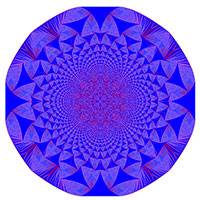
The Apollonian circle packing fractal is a quantification of the sandpile fractal's ability to remember that it used to live on a square grid. To humor mathematicians, picture a pile of sand grains - say, a billion - in one square of a vast sheet of graph paper. If four or more grains occupy a single square, that square topples by sending one grain to each of its four neighboring squares.
Environment - Mathematics - 26.02.2015
The Statistics of Climate Change
Professor Norman Fenton writes about his role co-presenting a forthcoming BBC Four documentary on climate change and the importance of three key statistics. I have the pleasure of being one of three presenters of a documentary called Climate Change by Numbers, to be screened on BBC Four on 2 March 2015.
Mathematics - Physics - 02.02.2015
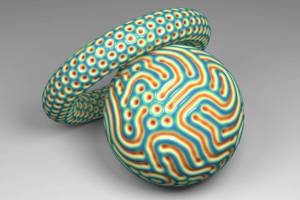
As a grape slowly dries and shrivels, its surface creases, ultimately taking on the wrinkled form of a raisin. Similar patterns can be found on the surfaces of other dried materials, as well as in human fingerprints. While these patterns have long been observed in nature, and more recently in experiments, scientists have not been able to come up with a way to predict how such patterns arise in curved systems, such as microlenses.
Life Sciences - Mathematics - 20.01.2015
New computation method helps identify functional DNA
Striving to unravel and comprehend DNA's biological significance, Cornell scientists have created a new computational method that can identify positions in the human genome that play a role in the proper functioning of cells, according to a report published Jan. The human genome is vast, totaling some three billion base pairs of nucleotides, the subunits of DNA.
Mathematics - Physics - 16.01.2015
Mathematical approach provides a new step in resolving the mystery of glass
Illustration of a Coulomb glass - a type of glass formed by electrons in disordered material: Electrons (red) in a random landscape, interacting with each other (yellow-orange lines). New research led by researchers at Penn State and the Argonne National Laboratory makes an important step towards understanding the mysterious properties of glasses.
Computer Science - Mathematics - 22.12.2014
'Text overlap' clutters scientific papers, arXiv analysis finds
Computer text analysis of a huge database of scientific papers shows a large amount of "text overlap," where authors use text from previous papers of their own and others, not always with attribution. This is not necessarily good or bad, Cornell researchers say. "Our first goal was to characterize the accepted practice, not to be judgmental," said Paul Ginsparg, professor of physics and information science and founder of the online arXiv collection of scientific papers, now maintained by Cornell University Library.
Mathematics - Life Sciences - 16.12.2014
Researchers develop more reliable method for working with mathematical models
Scientists from Imperial College London have developed a way to make the conclusions drawn from mathematical models more reliable. The work has implications for fields as diverse as medical research and ecology. Models are, by necessity, gross simplifications and, as such, there is always the risk that the model - and so the conclusions we draw - are wrong Most scientists choose to work with one mathematical model and change the input parameters to see what different outcomes result.
Computer Science - Mathematics - 12.12.2014
Imperial mathematician sheds new light on 50 year old algorithm
An Imperial mathematician has found a new way of formulating a 50 year old algorithm, used when describing the world using mathematical models. It is anticipated that the proposed technique, published this week in the Proceedings of the National Academy of Sciences (PNAS), will pave the way for greatly accelerating the calculations involved when making predictions about the behaviour of complex systems in many different areas of science and engineering.
Life Sciences - Mathematics - 03.12.2014
UCL professors use probabilities to persuade doubters skeleton is King Richard III
Two UCL professors led a key part of the new analysis of 'Skeleton 1'; which was discovered in a Leicester car park in 2012 on the site of the Grey Friars friary, the last known resting place of King Richard III. They used probability calculations to combine several different lines of evidence, producing an overall weight-of-evidence for the skeleton being that of King Richard III.
Mathematics - 03.12.2014
Carrot or stick?
What motivates people to cooperate in collaborative endeavors? "First carrot, then stick". Tatsuya Sasaki, mathematician from the University of Vienna, has put forth for the first time ever a mathematical proof of this process. The study is recently published online in the "Journal of the Royal Society Interface".
Health - Mathematics - 14.11.2014
Study predicts likely Ebola cases entering UK and US through airport screening
The team examined the current growth rate of the epidemic in West Africa alongside airline travel patterns Researchers at the University of Liverpool have found that screening for Ebola at airports could be an effective method for preventing the spread of the disease into the UK and US, but due to the long incubation period of the virus, screening won't detect all cases Published in the Lancet medical journal, the study used a mathematical model to test the probability of infected travellers from West Africa entering the UK and US.


Health - Today
AI was supposed to ease doctors' workload - instead they spend hours correcting errors
AI was supposed to ease doctors' workload - instead they spend hours correcting errors
Pharmacology - Today
International trial finds rapid diagnostic testing alone does not reduce antibiotic prescribing for respiratory infections
International trial finds rapid diagnostic testing alone does not reduce antibiotic prescribing for respiratory infections
Social Sciences - Today
Social background shapes how hard children work, according to a study by UC3M
Social background shapes how hard children work, according to a study by UC3M
Innovation - Today
With Robotics Innovation Center, CMU and Hazelwood Partners Sustain Community Collaborations
With Robotics Innovation Center, CMU and Hazelwood Partners Sustain Community Collaborations