

Pharmacology - Mar 19
GSK, University of Oxford and Imperial College London launch centre to create computer models of lungs, liver, kidneys and cartilage
GSK, University of Oxford and Imperial College London launch centre to create computer models of lungs, liver, kidneys and cartilage
Innovation - Mar 19
India's new wave of Hindu Religious Entrepreneurship is reshaping our interpretation of success
India's new wave of Hindu Religious Entrepreneurship is reshaping our interpretation of success

Veterinary - Mar 19
New RVC study challenges common beliefs on desirable behaviours in designer 'Doodle' crossbreeds
New RVC study challenges common beliefs on desirable behaviours in designer 'Doodle' crossbreeds
Agronomy & Food Science - Mar 19
Bird Flu Risk to Danish Cattle - New Tool Can Warn Farmers Before Infection Spreads
Bird Flu Risk to Danish Cattle - New Tool Can Warn Farmers Before Infection Spreads
Chemistry - Mar 19
Leipzig University and Center for the Transformation of Chemistry conclude collaboration agreement
Leipzig University and Center for the Transformation of Chemistry conclude collaboration agreement
Psychology - Mar 19
Analysis: Trying your best in a second language? Here's why native speakers seem so rude
Analysis: Trying your best in a second language? Here's why native speakers seem so rude
Computer Science - Mar 18
SDU is part of global initiative to bring mathematical certainty to modern computing and artificial intelligence
SDU is part of global initiative to bring mathematical certainty to modern computing and artificial intelligence
news
Swiss Federal Institute of Technology Lausanne, EPFL
Results 301 - 320 of 1375.
Mechanical Engineering - Health - 16.06.2023
Mechanics of the ideal surgical knot
Researchers have published a first study on the mechanics of surgical knots, with results that could be used to train surgeons to tie stronger, safer sutures - a skill that usually requires years of practice to master. Think about the last time you tied your shoe: maybe you tied it tightly, or tied multiple knots to ensure the laces wouldn't come undone.
Physics - Computer Science - 15.06.2023
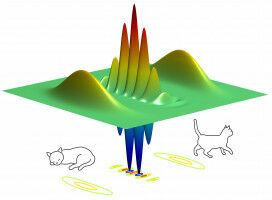
Drawing from Schrödinger's cat thought experiment, scientists at EPFL have built a "critical cat code" qubit that uses bosons to store and process information in a way that is more reliable and resistant to errors than previous qubit designs. Quantum computing uses the principles of quantum mechanics to encode and elaborate data, meaning that it could one day solve computational problems that are intractable with current computers.
Microtechnics - Innovation - 14.06.2023

Researchers have used Chat-GPT-3 to develop a robotic gripper for harvesting tomatoes, in a first demonstration of the artificial intelligence tool's potential for collaborating with humans on robot design. With their ability to process vast amounts of text data, and to use this information to answer prompts, neural networks known as large language models (LLMs) like Chat-GPT have been making headlines for their potential to change the way we write, learn, and even make art.
Astronomy & Space - 13.06.2023
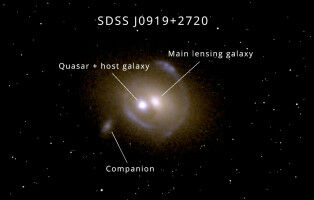
Scientists have managed to weigh - more precisely than any other technique - a galaxy hosting a quasar, thanks to the fact that it acts as a gravitational lens. Detection of strong gravitational lensing quasars is expected to multiply with the launch of Euclid this summer. A team of researchers from EPFL have found a way to use the phenomenon of strong gravitational lensing to determine with precision - about 3 times more precise than any other technique - the mass of a galaxy containing a quasar, as well as their evolution in cosmic time.
Health - Computer Science - 12.06.2023
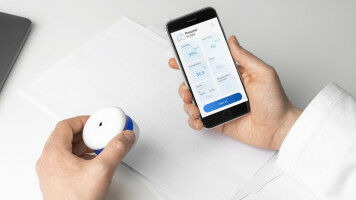
A new AI algorithm developed at EPFL and University Hospital Geneva (HUG) will power an intelligent stethoscope - Pneumoscope - with the potential to improve the management of respiratory disease in low-resource and remote settings. As air passes through the labyrinth of small passageways in our lungs, it makes a distinctive whooshing sound.
Physics - Life Sciences - 07.06.2023

Scientists have developed a new research instrument for observing biological tissue samples prepared using a method discovered about forty years ago by Nobel Prize winner Jacques Dubochet, emeritus professor at the University of Lausanne. Their instrument - the only one of its kind in the world - opens up promising new avenues of research.
Life Sciences - Health - 05.06.2023

Scientists reproduce key features of pathological protein aggregates found in the brain of patients with Lou Gehrig's disease and other neurological diseases, providing insight into the underlying mechanism and offering promising avenues for new therapies. Several neurodegenerative diseases, such as Alzheimer's, Parkinson's, and Lou Gehrig's Disease aka Amyotrophic lateral sclerosis (ALS), are caused by proteins that go stray and start to aggregate into fibrils that accumulate in specific brain regions.
Environment - Innovation - 01.06.2023

Researchers from EPFL and HES-SO Valais have modeled the Swiss energy system under the hypothetical constraints of carbon neutrality and energy independence by 2050. The results show that these two constraints could be met while reducing energy system costs by about 30% compared to 2020. A carbon-neutral and independent Swiss energy system in 2050 is theoretically achievable using the currently untapped local renewable energy resources.
Physics - 31.05.2023

Scientists show that a thin layer of plasma, created by ionizing air, could be promising as an active sound absorber, with applications in noise control and room acoustics. Did you know that wires can be used to ionize air to make a loudspeaker? Simply put, it's possible to generate sound by creating an electric field in a set of parallel wires, aka a plasma transducer, strong enough to ionize the air particles.
Physics - 30.05.2023
Breaking the ice over a 40-year problem of supercooled water
Researchers at EPFL have found a way to study water in "no man's land," a subzero temperature range where water crystallizes rapidly. Historically, the inability to access "no man's land" has prevented researchers from unriddling the anomalous nature of water, but the breakthrough method can now change that.
Computer Science - 26.05.2023

Researchers have worked with the International Committee of the Red Cross (ICRC) to develop a first of its kind, digital system to support humanitarian aid distribution. The design uses tokens to decentralize the storage and processing of recipients information, reducing the risk of harm, and uses advanced cryptography to enable accountability.
Life Sciences - Health - 24.05.2023

Neuroscientists and neurosurgeons from EPFL/CHUV/UNIL and CEA/CHUGA/UGA report in the journal Nature that they have re-established the communication between the brain and spinal cord with a wireless digital bridge, allowing a paralyzed person to walk again naturally "We have created a wireless interface between the brain and the spinal cord using brain-computer interface (BCI) technology that transforms thought into action.", summarizes Grégoire Courtine, Professor of Neuroscience at EPFL, CHUV and UNIL.
Health - 24.05.2023

Scientists at EPFL have developed a groundbreaking new technique for engineering biosensors that respond sensitively to specific biomolecules, enhancing cell migration and targeting in cancer treatment. The findings could lead to more precise control over cellular processes for a wide range of therapeutic applications.
Environment - 23.05.2023

Everything we do has a carbon footprint but are our perceptions of the emissions we generate on a daily basis aligned with reality? To find out, two researchers have launched Climpact a new tool to help separate fact from fiction. Whilst the environment, including our climate, came out as the main concern for Swiss people in 2022 , a global survey by the market research firm IPSOS has found that misconceptions are rife about the most effective climate solutions.
Innovation - 19.05.2023
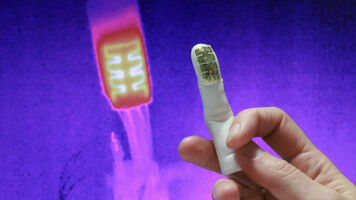
An unexpected discovery about temperature feedback has led to new bionic technology that allows amputees to sense the temperature of objects - both hot and cold - directly in the phantom hand. The technology opens up new avenues for non-invasive prosthetics. "When I touch the stump with my hand, I feel tingling in my missing hand, my phantom hand.
Pharmacology - 17.05.2023
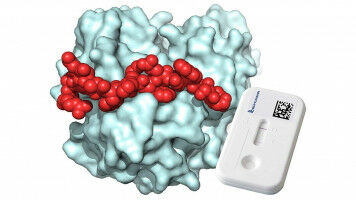
Scientists have developed a peptide that binds to the protein calprotectin, a marker of major inflammatory disorders, and shown that it is suitable for diagnostic tests. The use of synthetic peptides for sensing disease markers is of great interest as they are more precise, robust, and cheaper than antibodies commonly used in diagnostic tests.
Life Sciences - 11.05.2023
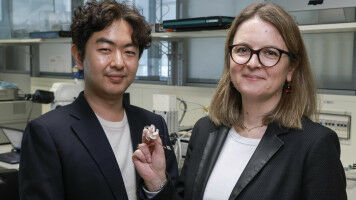
Scientists have developed electrode arrays that can be funneled through a small hole in the skull and deployed over a relatively large surface over the brain's cortex. The technology may be particularly useful for providing minimally invasive solutions for epileptic patients. Stephanie Lacour's specialty is the development of flexible electrodes that adapt to a moving body, providing more reliable connections with the nervous system.
Life Sciences - Chemistry - 10.05.2023

Scientists at EPFL have developed PeSTo, an AI model for predicting protein binding interfaces with proteins, nucleic acids, lipids, ions, and small molecules with high confidence. The model's low computational cost enables the processing large amounts of structural data, opening up opportunities for discovering new biology.
Physics - Materials Science - 09.05.2023

EPFL engineers have found a way to control the interactions between excitons - quasiparticles that may one day transport data and replace the electrons in electronic devices. The engineers' method involves applying an electric field to a two-dimensional (2D) semiconducting material. Electronic devices have become an essential feature of just about all aspects of modern society.
Life Sciences - Computer Science - 04.05.2023

A research team from EPFL has developed a novel machine-learning algorithm that can reveal the hidden structure in data recorded from the brain, predicting complex information such as what mice see. Is it possible to reconstruct what someone sees based on brain signals alone? The answer is no, not yet.


Pharmacology - Mar 19
GSK, University of Oxford and Imperial College London launch centre to create computer models of lungs, liver, kidneys and cartilage
GSK, University of Oxford and Imperial College London launch centre to create computer models of lungs, liver, kidneys and cartilage
Innovation - Mar 19
India's new wave of Hindu Religious Entrepreneurship is reshaping our interpretation of success
India's new wave of Hindu Religious Entrepreneurship is reshaping our interpretation of success
Veterinary - Mar 19
New RVC study challenges common beliefs on desirable behaviours in designer 'Doodle' crossbreeds
New RVC study challenges common beliefs on desirable behaviours in designer 'Doodle' crossbreeds
Agronomy & Food Science - Mar 19
Bird Flu Risk to Danish Cattle - New Tool Can Warn Farmers Before Infection Spreads
Bird Flu Risk to Danish Cattle - New Tool Can Warn Farmers Before Infection Spreads
Chemistry - Mar 19
Leipzig University and Center for the Transformation of Chemistry conclude collaboration agreement
Leipzig University and Center for the Transformation of Chemistry conclude collaboration agreement
Psychology - Mar 19
Analysis: Trying your best in a second language? Here's why native speakers seem so rude
Analysis: Trying your best in a second language? Here's why native speakers seem so rude
Computer Science - Mar 18
SDU is part of global initiative to bring mathematical certainty to modern computing and artificial intelligence
SDU is part of global initiative to bring mathematical certainty to modern computing and artificial intelligence